

Title: Dream
Artist: Ana Barros
Subject: A horizontal lineup of twelve draped figures split by a central void containing a luminous sphere
Visual Style: Symbolist (utilizing organic, archetypal forms)
Medium: Acrylic painting on canvas
Color Palette: Deep blues, slate grays, and white highlights
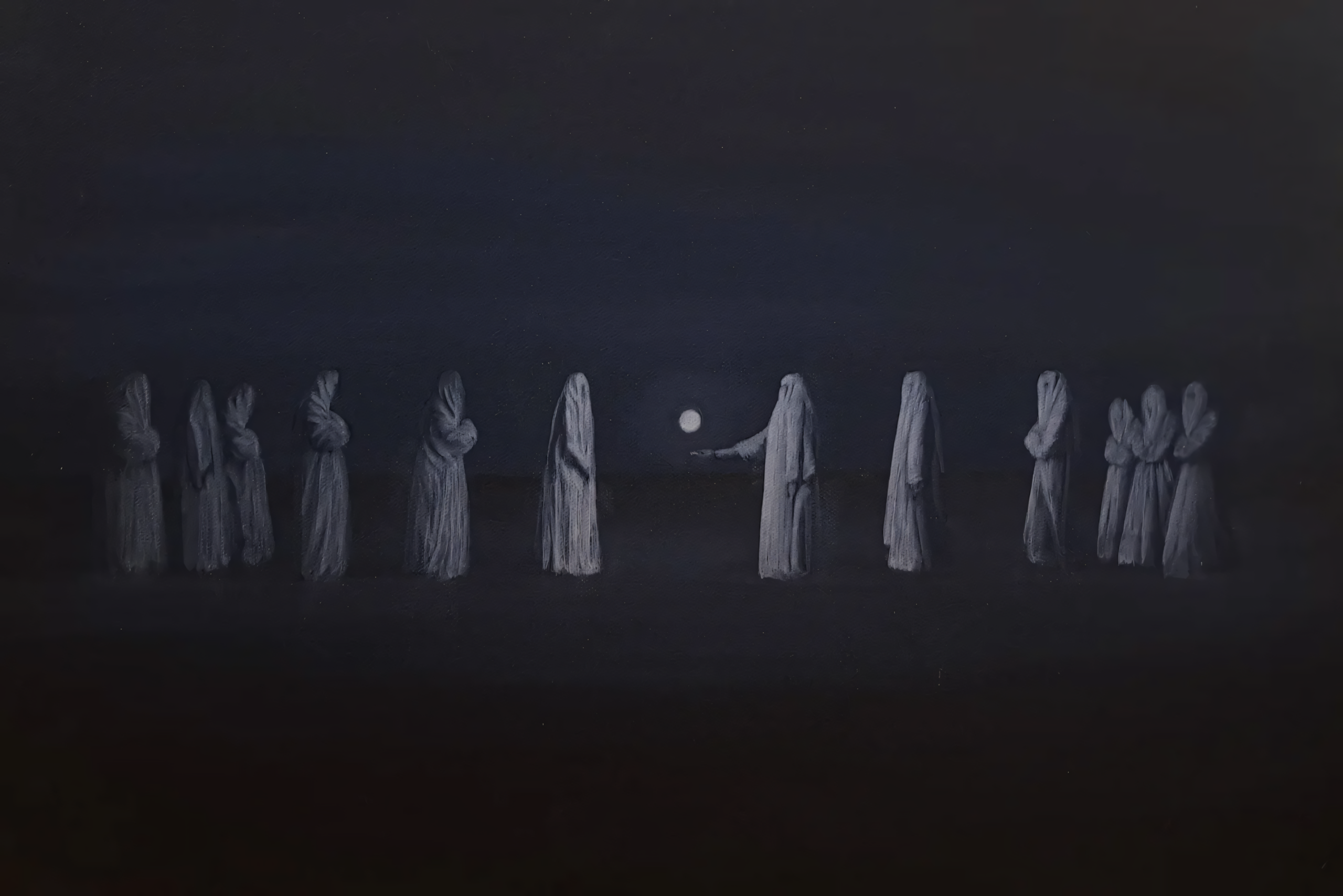
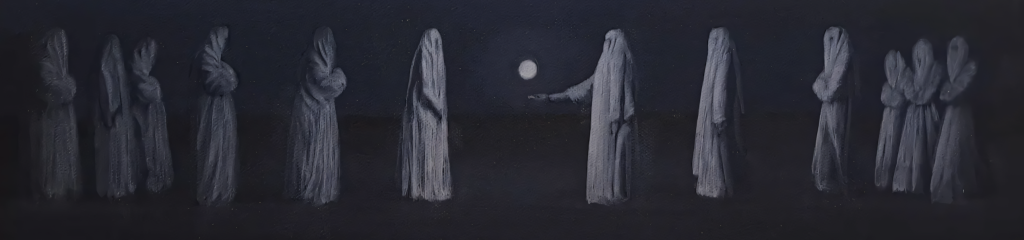
The painting titled Dream presents an study in the form of quiet mystery. At its core, the composition features a horizontal lineup of twelve draped figures positioned against a dark landscape. A prominent central void divides these figures into two equal groups of six, creating a symmetrical balance that structures the entire canvas from left to right. Within this central opening, a luminous sphere floats completely unsupported in the dark sky, serving as the focal point of the entire work.
The significance of this piece lies in its ability to communicate a sense of atmosphere and intrigue through a limited set of visual elements. By utilizing a minimalist approach to a surreal scene, the artwork establishes a contemplative space that invites prolonged observation. The contrast between the pale garments of the figures and the deep tones of the background ensures that the composition remains instantly legible in its secretive mood.
What We Are Looking At
An objective examination of this dream reveals an ordered composition set within a nocturnal environment. The canvas is divided horizontally into two primary zones by a very low horizon line that sits near the bottom quarter of the frame. The lower third of the canvas constitutes a solid, near-black ground plane that lacks visible texture, providing a heavy base for the entire composition. The upper two-thirds consist of a deep indigo and midnight blue sky, which features soft horizontal bands of slightly lighter grey and blue tones that suggest distant atmospheric gradients.
Arranged in a strict linear formation across the middle ground are twelve figures, each completely enveloped in long, white or light grey draped fabric resembling ceremonial robes. These figures are shaped as elongated rectangles that taper slightly at the top where the head is located. The garments completely conceal the faces, hands, and feet of the figures, with the sole exception of a single extended arm. The twelve figures are divided evenly by a wide central gap, creating a left procession and a right procession of six figures each.
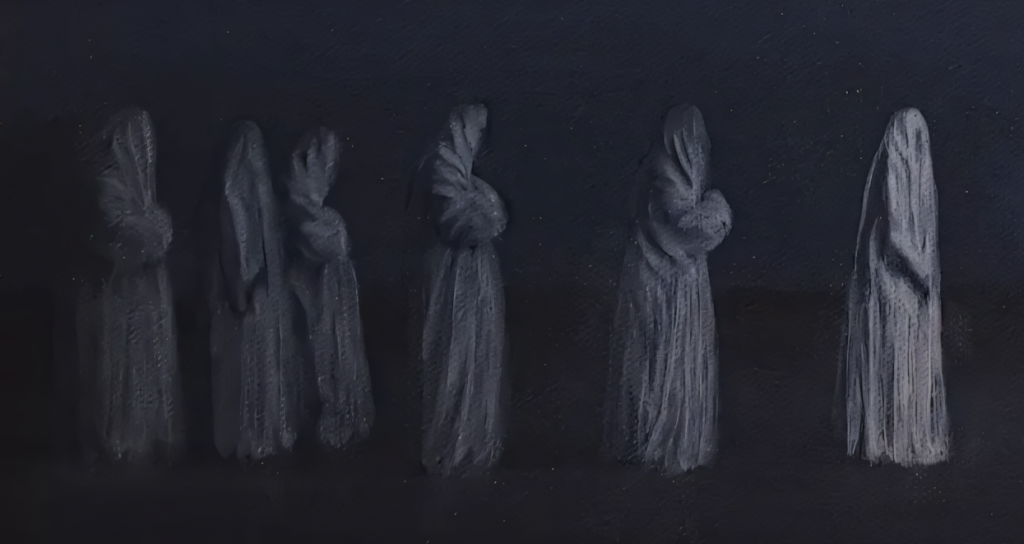
On the left side, the outermost figure stands in profile facing toward the center. The second and third figures are positioned close together, their garments nearly merging at the base to form a singular block of white tone. The fourth and fifth figures stand independently, displaying clear lines and sharp folds in their drapery that emphasize their upright postures. The sixth figure stands at the immediate edge of the central void, facing right toward the open space.
The central void itself is an open expanse of dark space that separates the two groups, spanning a width roughly equal to three individual figures. Exactly in the middle of this gap, a circular white orb floats suspended in the air, positioned just above the dark ground plane and centered vertically within the opening.
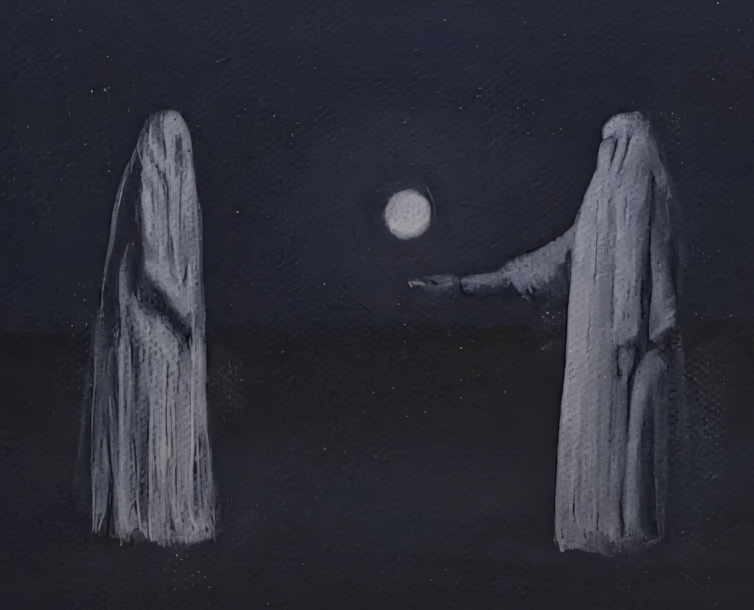
On the right side of the canvas, another group of six figures completes the lineup. The innermost figure of this right group stands directly opposite the sixth figure, facing left toward the floating orb. This figure extends a single arm out from beneath its white drapery, reaching toward the sphere with an open hand positioned slightly beneath the object. The remaining five figures on the right extend toward the edge of the canvas. The second figure in this sequence stands straight, facing left, while the third stands slightly isolated. The final three figures on the far right are clustered tightly together in a dense formation, with their shoulders overlapping and their garments blending into a mass of light value that anchors the right edge of the composition.
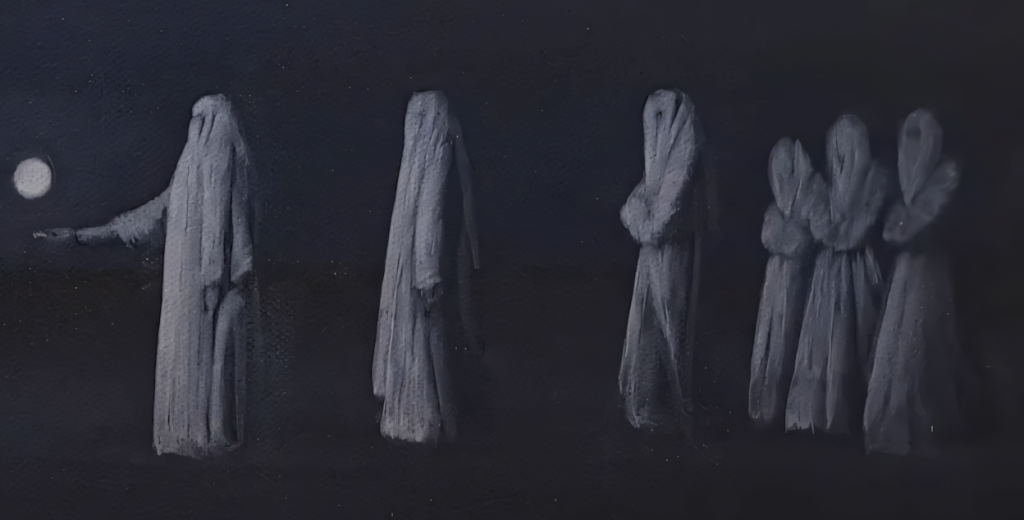
The lighting across the entire scene is localized and internal, with a white glow emanating from the central orb and the surfaces of the draped figures, casting shadows within the folds of the fabric while leaving the surrounding landscape in complete shadow.
The Deeper Meaning
The conceptual narrative of the painting is rooted firmly in the visible relationships between its structural components, turning a simple gathering into an exploration of community and the unknown. The presence of twelve uniform figures arranged in a balanced configuration naturally suggests a unified community facing a common experience. Because the figures are completely covered in identical draped garments, all indicators of individual identity, age, gender, or social status are entirely removed from the canvas. This deliberate design choice transforms the figures into archetypal representations of a human collective, emphasizing a shared state of being rather than individual experience.
The central division of the line creates a thematic boundary, separating the community into two balanced halves and isolating the floating sphere within a void. This spatial arrangement introduces a theme of a collective confrontation with a celestial element, highlighting the boundary between the human realm and the mysterious object. The collective focus of the figures, directed inward toward the open space, combined with the explicit physical gesture of the extended arm, points toward a shared ritual or a moment of silent communication.
The single extended hand acts as a crucial narrative bridge, representing a universal human impulse to establish contact and interact with a mysterious presence. The empty sky and the low horizon line amplify the scale of the environment, placing this interaction within an infinite, timeless setting. This choice reinforces a sense that community exists in a remote, quiet universe where their shared focus is the sole source of light and meaning.
The floating sphere, left entirely unexplained by any surrounding context, remains a symbol of mystery, allowing the painting to function as a broader reflection on how human societies gather and seek connection with forces beyond their immediate understanding.
Artistic Decisions
The visual effectiveness of the artwork depends on a series of deliberate design choices that govern its composition, layout mechanics, and functional communication purposes. The composition is built upon a linear framework and a symmetrical balance, which distributes visual weight evenly across the horizontal axis of the canvas. This balanced arrangement ensures clarity and prevents the multiple figures from creating visual clutter.
The primary mechanism used to establish a visual hierarchy is the strategic placement of the central void. By breaking the continuous horizontal line of figures with a wide gap, the artist creates an immediate point of interest that captures the viewer’s attention. The inclusion of the round sphere within this gap introduces a geometric contrast, as the soft circle cuts through the rectangular standing figures.
The color palette is strictly limited to a low-saturation, monochromatic scheme dominated by deep blues, charcoal blacks, and stark whites. This restricted palette serves a dual purpose: it unifies the disparate elements of the composition and ensures that the white garments provide maximum value contrast against the background.
The lighting mechanics function through internal illumination, where light appears to emanate directly from the central orb and the figures themselves, avoiding any external source like a sun or moon outside the frame. This localized light source allows for a detailed rendering of the fabric folds, creating a distinct chalky texture on the cloaks through soft shading and smoothly blended transitions. The surface of the paint is evenly applied, which enhances the clean, minimalist appearance of the background sky and ground plane.
Emotional Impact
The structural and color choices within the painting exercise a precise control over the viewer’s psychological journey, cultivating an atmosphere of deep calmness and solemnity. The dominant dark blue and black tones establish a nocturnal mood that encourages a reflective state of mind. The vastness of the empty sky, combined with the low horizon line, creates a powerful feeling of scale that makes the illuminated figures appear small within the landscape.
The repetitive placement of the vertical figures establishes a steady visual rhythm. As the observer’s eye moves across these uniform forms, the predictability of the pattern induces a meditative, peaceful feeling that slows down the viewer’s focus. However, this tranquility is carefully balanced by the tension introduced at the center of the canvas. The sudden gap in the line of figures functions as a dramatic pause, creating a moment of suspense that halts the eye’s movement across the frame.
The extended arm of the figure reaching toward the floating sphere generates a sharp point of anticipation. Because the hand remains suspended just below the orb without making contact, the viewer is held in a state of permanent expectation of a frozen moment right before an event occurs. The cool color temperature of the entire composition reinforces the silent quality of the world, while the soft, localized glow of the orb provides a gentle point of focus that keeps the dark landscape from feeling overwhelming or threatening, resulting in a balanced emotional experience that beautifully blends peace with mystery.
Why This Work Matters
The artwork achieves its lasting value through a display of visual and structural clarity. In a creative culture often dominated by intricate details and loud, complex narratives, this painting stands out by demonstrating how much can be communicated through a minimal selection of forms.
The takeaway value of the work rests on its ability to generate an enduring sense of mystery using only twelve draped figures, a dark landscape, and a single floating circle. The conceptual quality of the piece is elevated by its reliance on geometric structure and value contrast to create meaning, rather than relying on explicit storytelling. This abstraction allows the imagery to remain universal, ensuring that any viewer can engage with its themes without needing specific external knowledge.