
Title: Venetian Grand Canal
Artist: Dave Al Bahrani-Peacock
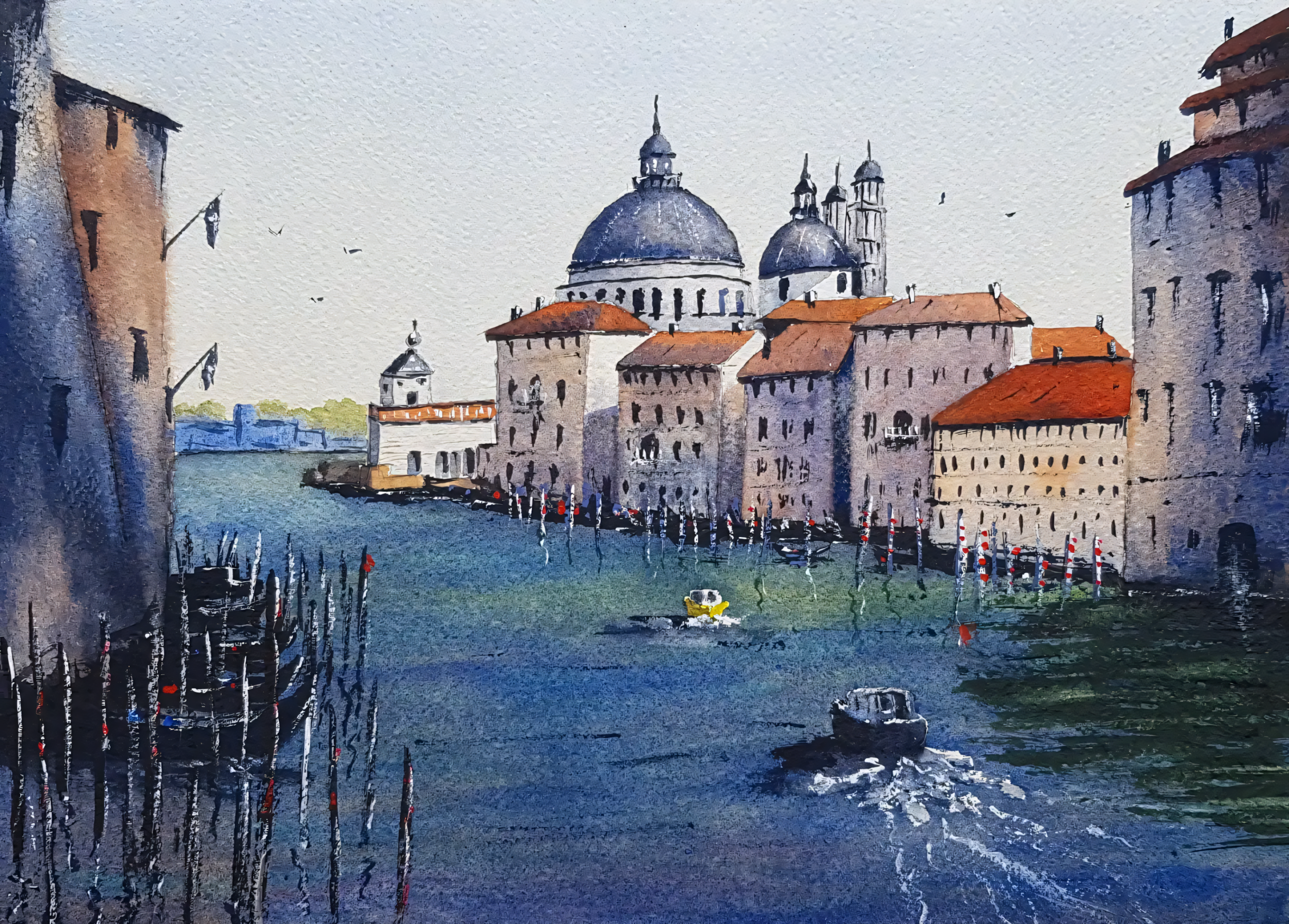
Subject: Venetian Grand Canal with a domed basilica
Visual Style: View painting with linear perspective
Medium: Watercolor washes on textured paper.
Color Palette: Complementary pairing of blue, beige and terracotta
Introduction
The watercolor painting labeled Grand Canal in Venice represents an engagement with one of the most celebrated urban vistas in the history of art. By utilizing the fluid properties of the watercolor medium on a granulated paper surface, the artwork offers a comprehensive study of the Venetian Grand Canal.
This composition focuses specifically on the intersection of monumental civic architecture and the water corridors that define the daily existence of the city. For many centuries, painters from various traditions have traveled to this unique place to capture its atmosphere. Each new interpretation provides a fresh perspective on how light interacts with stone and water. In this particular piece, the artist demonstrates a traditional approach to the medium, allowing wet washes to merge and flow across the canvas to suggest the natural movement of the sea. By balancing the solid geometric forms of the flanking buildings with the soft, light-filled expanses of the sky and the open canal, the painting explores the connection between human civilization and the aquatic environment. As an exhibition object, the painting rewards close inspection of its material qualities, where the texture of the paper contributes to the depiction of aged masonry and water movement.
In the image
In this painting, the visual space is divided into distinct zones that organize the Venetian landscape. The lower half of the composition consists of a wide expanse of blue water representing the Grand Canal.
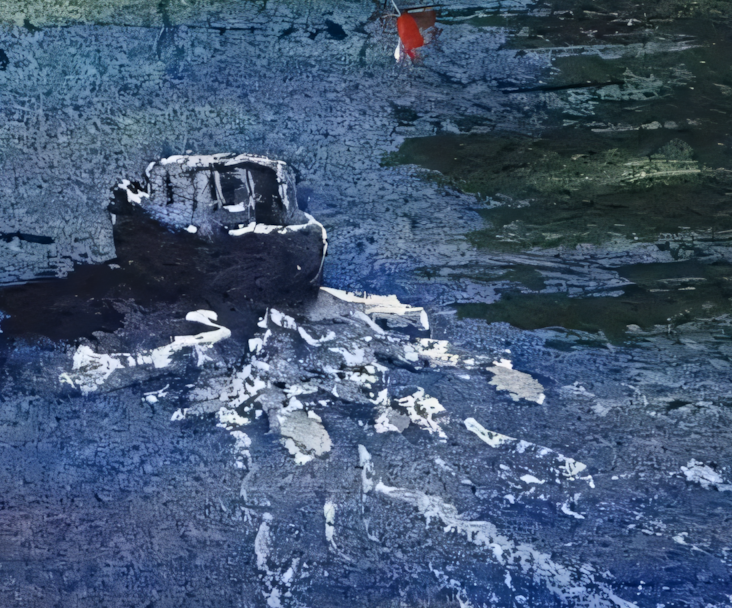
In the lower right quadrant, a dark transport boat moves forward, creating a white wake that spreads out in a series of light-colored lines across the darker surface. The water itself shows a subtle transition, moving from a deep indigo near the bottom edge to a greenish-blue hue towards the middle distance, where it reflects the lighter tones of the sky.
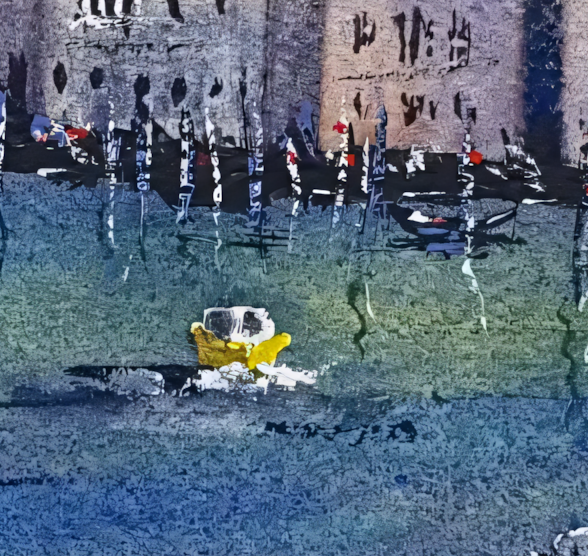
Further back in the middle ground, a smaller boat with a distinctive yellow upper section travels across the canal, leaving its own small trail of white foam. The left side of the painting is bounded by a tall, dark building rendered in heavy brown, blue, and grey tones. This structure remains in shadow, and two dark flags hang from rods attached to its facade.
Along the base of this building, several boats are clustered together near a dense collection of wooden mooring posts. These stakes feature alternating bands of white, blue, and red paint, and they extend backward into the middle ground in a straight line. On the right side of the canal, a row of multi-story buildings stretches into the distance.
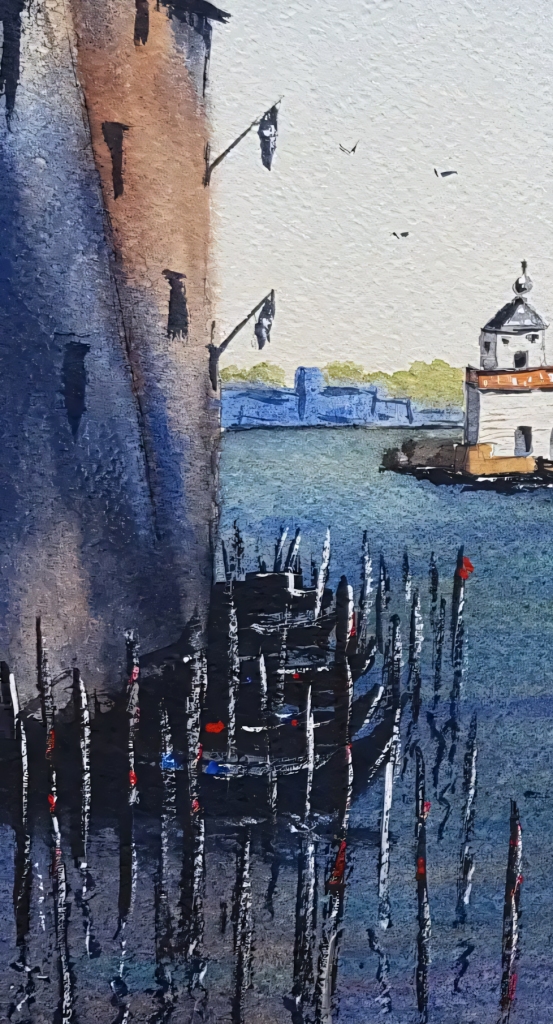
These structures are painted in warm cream and beige tones, capped with orange and terracotta roofs. The walls of these buildings are punctuated by small windows arranged in rows, suggesting a dense urban layout. The water directly beneath these buildings shows dark green and black ripples, indicating shadows cast by the architecture. The central background is dominated by the massive form of the Basilica of Santa Maria della Salute.
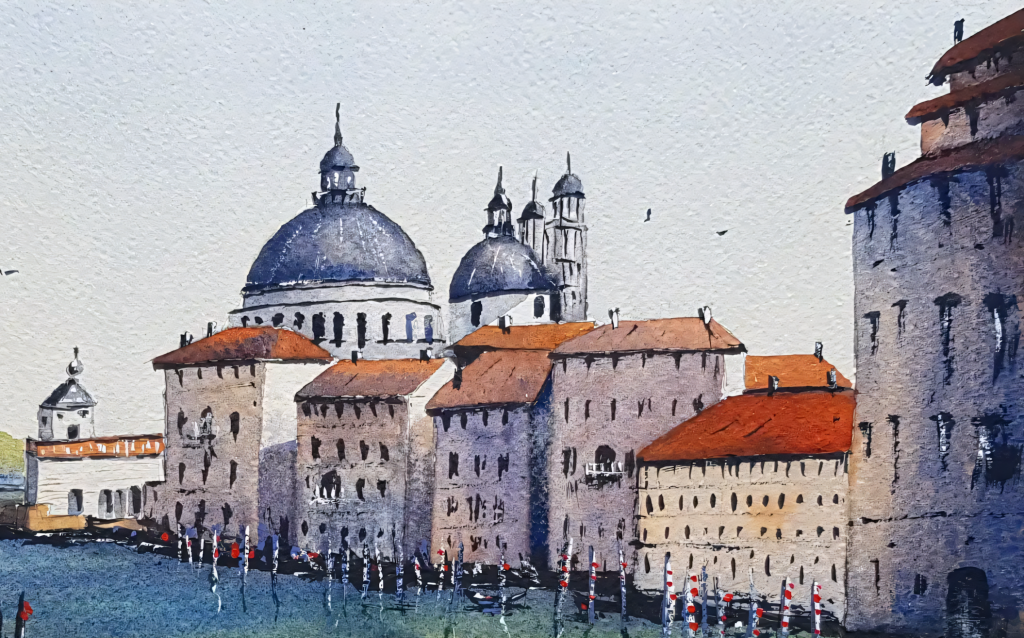
The main dome is painted in a soft blue-grey hue and sits atop a high, circular drum decorated with white panels and architectural scrolls. To the right of the main dome, a smaller secondary dome and two slender bell towers rise against the sky. On the far left, where the canal turns, a white building with a small grey cupola stands on a distant point of land, balanced by a blue strip of distant shoreline on the horizon.
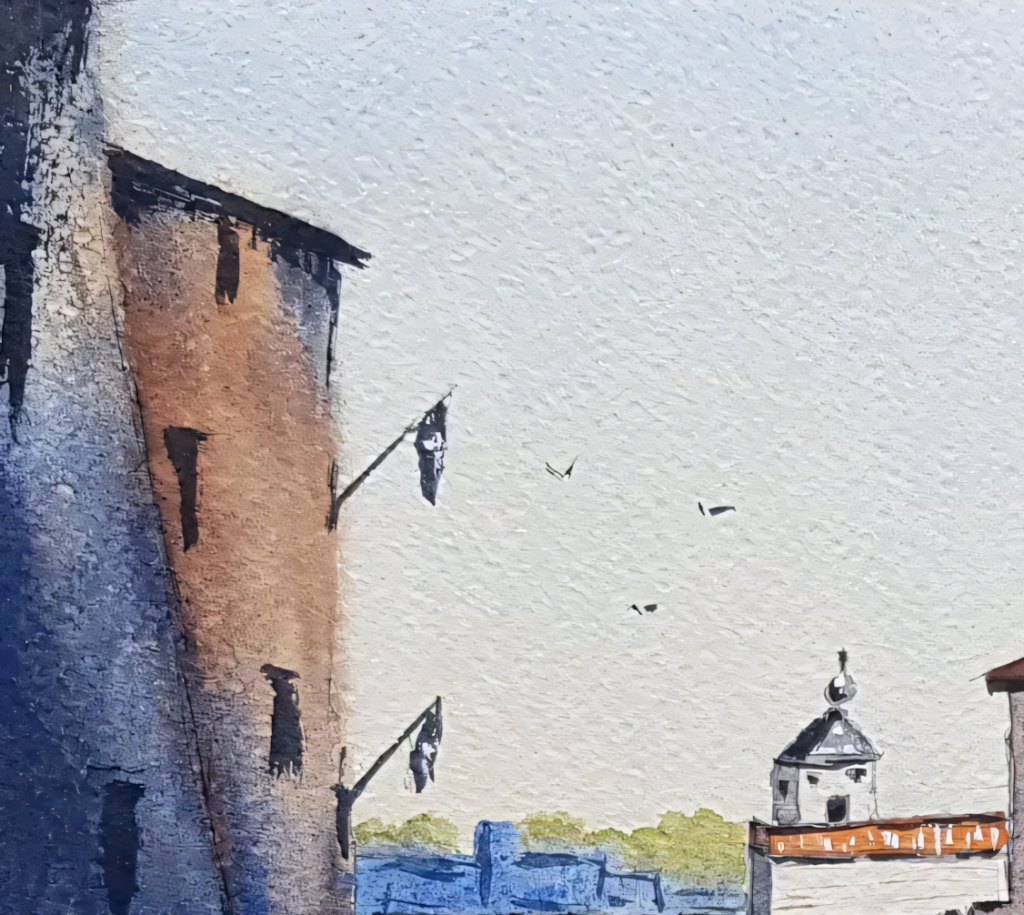
The sky occupies the upper third of the image, presented as a flat, light grey wash that highlights the rough texture of the paper. Several small, dark, v-shaped markings are scattered across the sky, representing birds in flight.
Behind the Facades
The thematic core centers on the relationship between historical permanence and the transient nature of human activity. By placing the mass of the basilica at the visual climax of the painting, the artwork emphasizes the enduring legacy of local cultural identity. The grand dome stands as an unchanging monument that has watched over the city for centuries representing shared history.
In contrast, the moving boats introduce the concept of daily human labor and temporary transit. The prominent white wake of the foreground boat provides a clear visual record of movement, showing how human energy cuts through the environment before dissolving back into the water. This interaction illustrates the fleeting nature of individual actions when viewed against the backdrop of an ancient city.
The numerous wooden stakes that line the canal serve a practical purpose, but they also function as a visual symbol of organization. By driving these poles into the muddy floor of the lagoon, the inhabitants have established order and boundaries within a fluid environment. The composition frames this narrative by using a stark contrast between light and shadow. The dark, shadowed building on the left represents the private, hidden aspects of Venetian life, while the illuminated buildings on the right celebrate the public beauty of the city architecture.
The choice of colors also reinforces this thematic balance. The warm terracotta roofs suggest human habitation, while the cool blue water represents the powerful natural forces that surround and sustain the city. This juxtaposition highlights a theme of balance, where humanity adapts to live within natural constraints instead of trying to dominate the environment. The small birds flying high in the sky expand this narrative, connecting the stone structures and waters to a wider sense of belonging.
Artistic Decisions
The structural clarity of Grand Canal is achieved through several deliberate design choices regarding perspective, color theory, and material handling. The artist employs a classic compositional technique by using the architecture as a frame to control the viewer’s eye movement.
The dark, high-contrast wall on the left functions as a visual barrier that prevents the gaze from wandering off the edge of the canvas. This heavy shape directs the eyes inward and downward onto the surface of the canal. Linear perspective is established through the converging lines of the buildings on the right and the receding row of mooring stakes on the left. These lines meet at an implied vanishing point near the base of the distant basilica, creating a sense of depth and guiding the viewer through the spatial layers of the scene.
The artist establishes a clear rhythm by contrasting the vertical lines of the mooring poles and building edges with the broad horizontal bands of the water, architecture, and sky. This grid-like underlying structure anchors the composition, ensuring that the fluid nature of the watercolor medium does not result in visual confusion. The distribution of visual weight is balanced across an asymmetrical layout. The massive dark value on the left is counterbalanced by the bright colors and complex rooflines on the right side.
Color theory is used effectively to create atmospheric perspective. The artist relies on a complementary color relationship between the cool blues of the water and the warm orange-reds of the terracotta roofs. This contrast makes the architectural details stand out clearly against the aquatic background.
The central dome is rendered in a desaturated blue-grey, which allows it to recede naturally into the background sky without losing its monumental scale. The small yellow accent on the mid-ground boat is an interesting choice, serving as a focal point that enlivens the center of the composition and breaks up the large zones of blue. The handling of the watercolor medium is visible in the fluid washes and the preservation of paper texture. The artist allowed the paint to settle into the grain of the paper to suggest the weathered surfaces of old brick and plaster.
Value contrast is used with precision, particularly where the white foam of the boat wake meets the deep blue of the foreground water.
Cultural and Historical review
From a cultural and historical perspective, Grand Canal fits into the established tradition of Venetian landscape art, specifically the genre of view painting that became prominent during the grand tour era. The visual details preserved on the canvas offer direct evidence of Venice’s unique identity as a maritime empire and a center of religious devotion.
The depiction of the Basilica of Santa Maria della Salute references a major historical event, as this church was constructed in the seventeenth century to celebrate the end of a devastating plague outbreak. Its dominant position in the painting reflects the historical importance of faith and civic gratitude in Venetian culture.
The numerous wooden poles, known locally as bricole, reminds us of the engineering required to maintain a city built entirely on water. For centuries, these stakes have been used to mark safe channels through the shallow lagoon and to provide mooring points for all types of vessels. The cluster of dark gondolas on the left represents the traditional mode of transport that has come to define the culture of the region.
At the same time, the inclusion of a motorized transport boat in the foreground documents the ongoing evolution of the city. This detail shows how Venice functions as a modern, working community that integrates contemporary technology into an ancient setting. The painting illustrates a cultural landscape where the physical reality of the water act as a constraint for architecture, transport, and daily routine, preserving a visual record of a society shaped by its unique geography.
Significance of this work
The lasting value of this artwork lies in its ability to present a highly familiar cultural landmark with technical clarity and compositional control. While the Grand Canal has been recorded by numerous artists over the centuries, this painting avoids becoming a cliché by focusing on the visual mechanics of the environment.
Strength of the artwork is found in its balanced depiction of opposing forces, showing the permanent weight of stone architecture alongside the fluid movement of the sea. The artist demonstrates great skill in managing the watercolor medium, using standard techniques to achieve a sophisticated distribution of light and shadow.
The composition is notable for its use of dramatic shadow on the left framing building, which creates an effective entry point for the eye and enhances the overall depth of the scene. The piece also succeeds in capturing a sense of time, using the active wakes of the boats to show that Venice is an active city instead of a static museum display.
This attention to detail, combined with a harmonious color palette, ensures that the image remains engaging. It reminds the audience of the enduring beauty of watercolor landscape painting and its unique capacity to convey atmosphere, light, and of course – history.