

Title: Greek Cosmogony
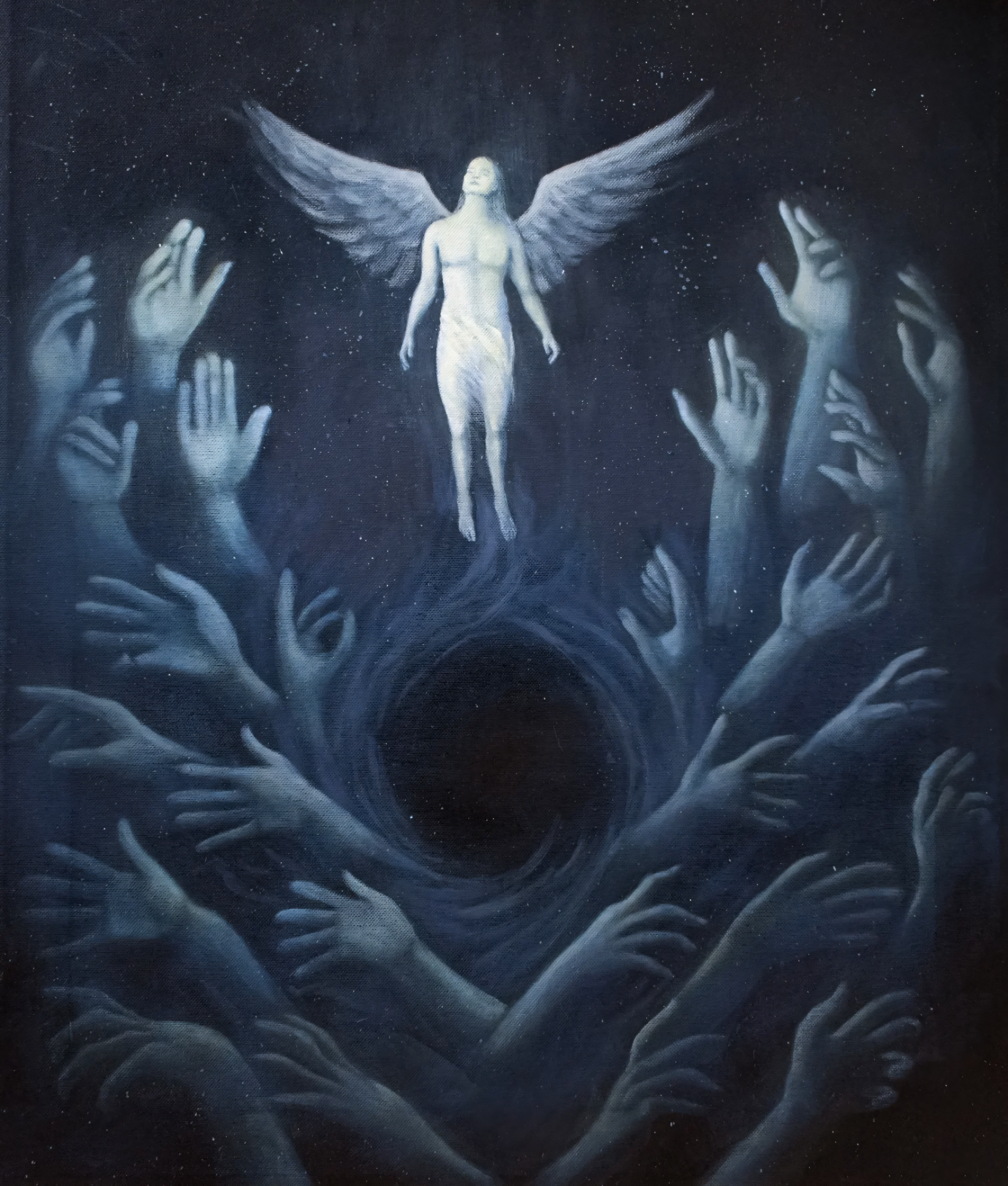
Artist: Ana Barros
Subject: A winged figure ascending toward a starry sky, leaving behind a dark vortex of reaching arms
Visual Style: Symbolist (utilizing organic, archetypal forms).
Medium: Acrylic painting on canvas
Color Palette: Deep blues, slate grays, and white highlights.
Introduction
Visual art has long served as a medium for exploring mysteries of existence, capturing the eternal tension between structure and formlessness across human history. The painting stands as a compelling modern contribution to this allegorical tradition, offering a meditation on cosmic origins and existential progression. Through a carefully orchestrated composition, the work examines how order emerges from primordial depths, presenting a visual thesis on the origins of structural harmony.
The canvas draws inspiration from classic philosophical inquiries into the nature of the cosmos, utilizing a symbolic vocabulary that resonates with the traditional principles of the nineteenth-century Symbolist movement. Rather than relying on literal historical narratives, the piece communicates through archetypal forms that speak directly to the subconscious human understanding of balance.
This analytical narrative will explore the precise visual mechanics, structural choices, and thematic undercurrents that allow the artwork to function simultaneously as a commentary on ancient mythology. By examining the painting’s structural geometry, its color choices, and its use of tonal contrast, we can decode the relationship between the individual elements and the overarching philosophical message.
The canvas ultimately provides an exploration of cosmic renewal, demonstrating how creative energy can organize the chaotic forces of nature into a unified whole. This piece invites viewers to contemplate their own placement within the grand cycles of order and chaos, making it a significant work of allegorical art that bridges ancient philosophy with modern existential contemplation.
The exclusion of unnecessary decorative elements forces a direct confrontation with its core themes, ensuring that the impact remains completely uncompromised, and engaging for a contemporary audience seeking meaning.
What we are looking at
An objective examination of the canvas in the painting reveals a meticulously organized composition divided into distinct horizontal and vertical registers that balance movement with stillness.
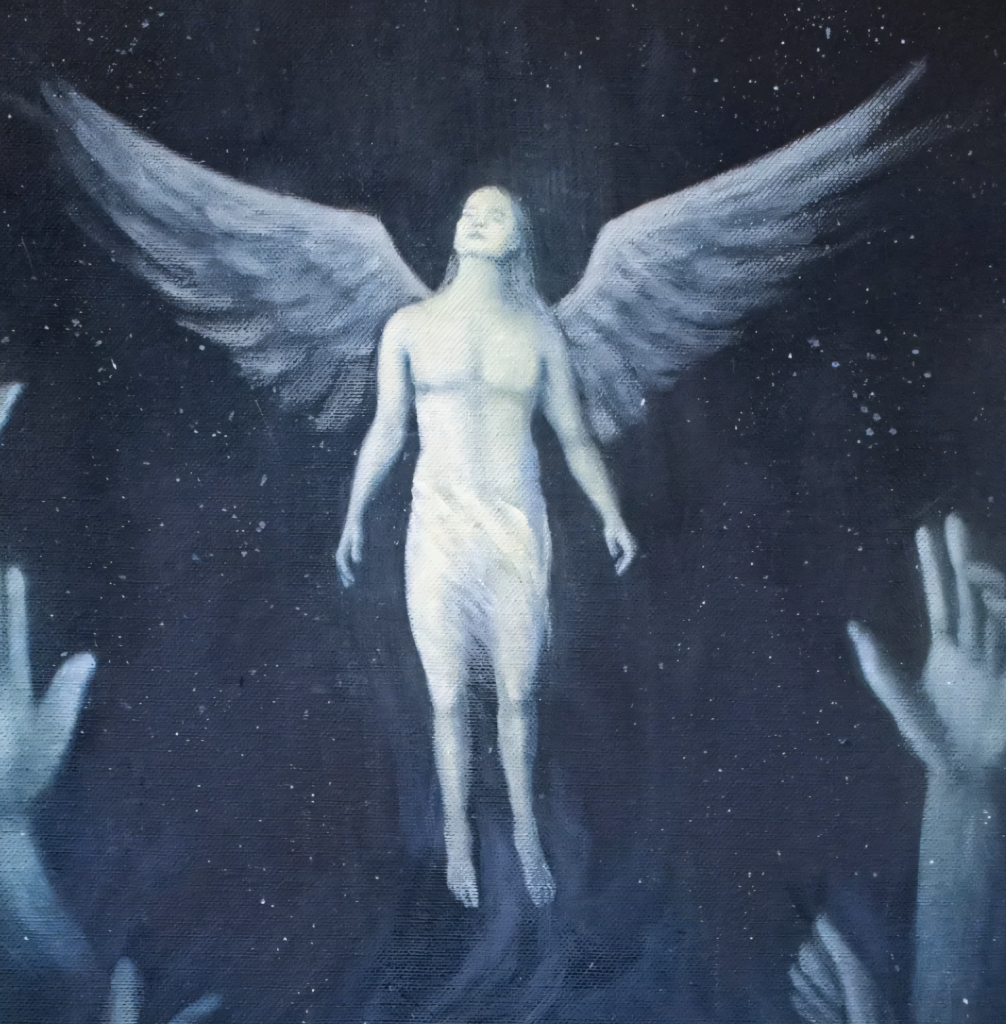
In the upper register of the canvas, a humanoid figure dominates the space, positioned along the central vertical axis to anchor the entire painting. This figure possesses a pair of large, fully extended wings that spread across the upper third of the painting. The feathers are rendered with fine strokes of white and light gray paint, creating a sense of weightlessness.
The figure’s torso, waist, and limbs are defined by bright white highlights that contrast against the dark background, while the head is tilted back, facing directly upward toward the top edge of the frame in an attitude of contemplation.
The background of this upper region consists of a dark field populated by hundreds of tiny white flecks, which directly mimic the appearance of a starry night sky.
Moving down into the central register, the composition features a circular void that acts as the physical pivot of the lower halves. This central space is a black hole that serves as the visual anchor and gravity well for the lower half of the painting. Surrounding this dark circle are dynamic, swirling brushstrokes executed in varying shades of deep blue and slate gray. These curved lines wrap around the central void in a concentric pattern, giving the distinct impression of a rotating vortex spinning inward.
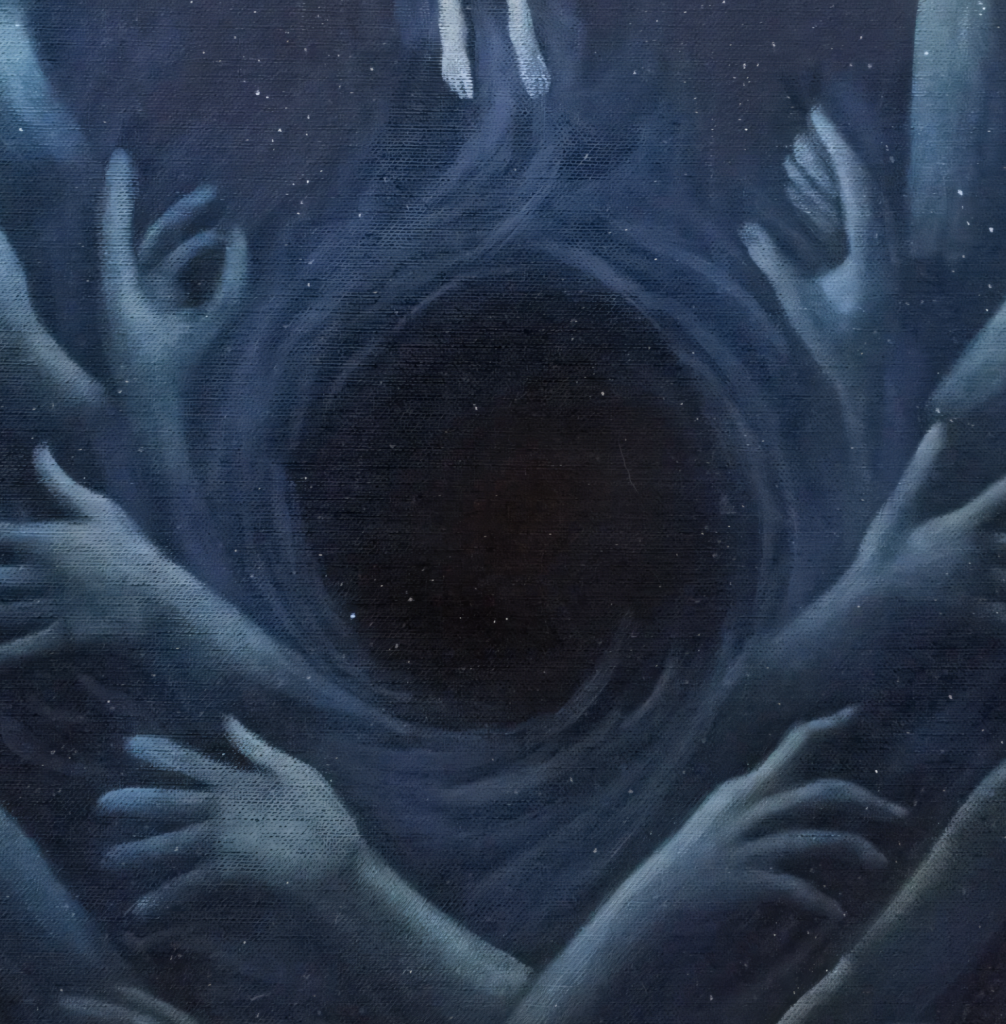
The lower and lateral registers of the canvas are filled with an dense arrangement of human limbs. Dozens of arms and hands emerge from the bottom and sides of the frame, creating an overlapping wall of human forms. In the lowermost portion, several forearms cross over one another in a stable horizontal alignment, establishing a solid foundation for the composition.
From this base, numerous arms extend upward along the left and right edges of the canvas. The hands are depicted in a variety of highly expressive postures. Some display fully extended fingers pointing directly toward the upper winged figure, while others feature curved palms and slightly bent fingers that follow the curved contours of the central vortex.
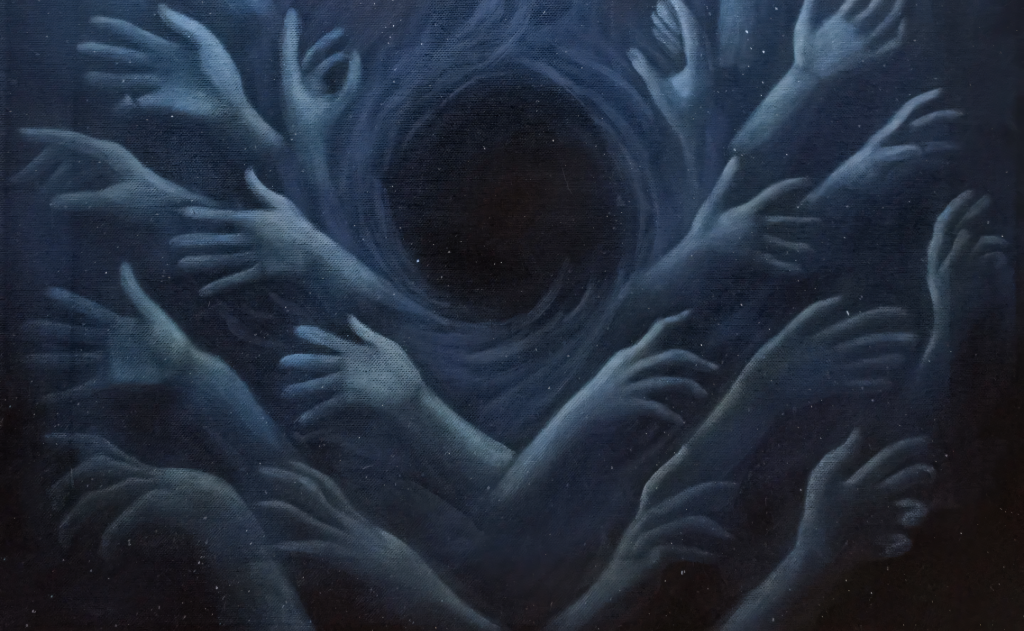
The entire anatomical arrangement forms a frame that encircles the central abyss, effectively channeling the viewer’s attention from the chaotic base toward the illuminated entity above. The execution relies on a monochromatic color scheme dominated by midnight blue, slate gray, and bright white, with visible paint texture apparent across the canvas surface, highlighting the deliberate physical application of medium onto the support.
Meaning behind the image
The thematic core of this painting centers on the philosophical transition from primordial disorder to cosmic harmony, providing a literal map of emergence. Based on the visual evidence and supported by ancient traditions, the painting illustrates the genesis of structure within the universe.
The lower portion of the canvas, with its thicket of grasping hands and overlapping arms, represents the concept of primal Chaos. This region embodies the ungovernable forces of nature, a state of existence characterized by multiplicity restless movement.
The central black void acts as a literal and symbolic womb of creation, a swirling abyss where potential existence remains dormant and disordered. Rising cleanly out of this turbulent vortex is the illuminated humanoid figure, which represents the primordial force of Eros, or cosmic love. In this context, love is understood as an organizing principle rather than a simple human emotion or romantic attachment.
It is the creative impulse that subdues chaos, bringing definitive form to the formless and establishing order within the void. The figure’s physical separation from the reaching hands below signifies the ultimate triumph of harmony over discord. While the limbs below remain trapped in an struggle around the abyss, the winged entity achieves liberation, ascending into the serene expanse of the starry sky.
The figure’s upward gaze emphasizes an intentional focus on higher ideals and spiritual elevation, turning away from the darkness below. The wings serve as a universal symbol of celestial liberty, showing that the ultimate trajectory of creative energy is one of ascent. The artwork communicates a powerful message of hope and cosmic order, asserting that even within the heart of deepest confusion, a force operates to shape a meaningful reality.
This message carries universal relevance, suggesting that human experience mirrors this cosmic cycle, where individuals must constantly navigate turbulent environments to achieve personal clarity and purposeful direction. The work posits that order is an active achievement, requiring continuous upward momentum to break away from the pull of primal entropy.
Artist Decisions
The visual impact is achieved through a series of highly deliberate design decisions that reinforce its thematic message through visual mechanics. The artist employs a vertical compositional axis, creating a clear hierarchical progression from the bottom of the canvas to the top. This verticality naturally guides the viewer’s eye on an upward trajectory, mimicking the physical act of ascension depicted in the narrative.
To balance the intense movement of the lower register, the composition utilizes a symmetrical arrangement that lends a stability to the canvas. The arms on the left side of the frame roughly mirror the arms on the right side, establishing a sense of stability and structural permanence that counters the chaotic nature of the individual limbs.
Tonal contrast serves as the primary mechanism for directing viewer attention. The winged figure is rendered with the brightest highlights on the entire canvas, isolating it completely from the surrounding darkness. This contrast ensures that the entity remains the undisputed focal point, drawing the eye immediately before allowing it to explore the rest of the composition.
Color choice plays an equally critical role in the painting’s communicative function. The monochromatic palette, dominated by deep blues unifies the diverse elements of the composition into a coherent whole. By utilizing the same color temperature for both the human anatomy and the cosmic void, the artist suggests that all these components are part of an interconnected system rather than separate entities.
The dark blue tones also infuse the scene with a sense of mystery and reverence, befitting a mythic creation narrative. Finally, the visible texture of the paint on the canvas surface adds a tactile quality to the work. This texture emphasizes the handmade nature of the artwork, reminding the audience of the human agency involved in shaping this cosmic vision, turning paint into a permanent testament to structural order.
Emotional Impact
The choices within the artwork conspire to guide the viewer through a carefully calibrated psychological journey, moving from a state of heavy tension to one of profound tranquility. The lower portion of the canvas generates an initial feeling of restlessness, weight, and confinement. The central vortex pulls the viewer’s gaze inward, evoking a sense uncertainty or the scale of the unknown. This area mimics the psychological experience of being caught within a chaotic environment where clear direction is absent.
However, the painting prevents this claustrophobic atmosphere from becoming oppressive by providing a clear visual escape route. The transition into the upper register offers an immediate emotional release and a sensation of relief. The expansive negative space surrounding the winged figure allows the composition to breathe, inducing a feeling of openness and serenity. The calm, balanced posture of the central entity, combined with its steady upward gaze, projects a sense of clarity and peace.
The surrounding background of distant stars enhances this effect, transforming the void from a place of turbulence into a realm of infinite wonder. The viewer is left with a deep sense of reassurance. This emotional trajectory acts as a visual catharsis, mirroring the psychological resolution that accompanies the conquest of internal or external turmoil.
Cultural Context
The visual narrative is deeply rooted in the foundational myths of ancient Greek philosophy, specifically referencing early descriptions of the universe’s origin as outlined in ancient texts. Ancient thinkers viewed Chaos as the initial cosmic womb from which the universe was pulled. According to these ancient traditions, Chaos was the primal state of existence, a raw, formless force that contained the undifferentiated potential of all things. From this primordial condition emerged three powerful forces, the most significant of which was Eros. In contemporary culture, Eros is frequently reduced to a deity associated purely with romantic passion or physical desire. However, in early Greek cosmogony, he possessed a far more fundamental role in the cosmic hierarchy. Early philosophers viewed Eros as the primordial energy of attraction and cohesion responsible for bringing order to the ungovernable void.
Eros was the force that unified disparate elements, which allowed life to emerge from its potential. The painting explicitly visualizes this philosophical framework through its arrangement. The vortex and limbs accurately depict the initial state of cosmic disorder, while the winged figure embodies the organizing, transcendent power of Eros. By portraying the figure ascending above the abyss, the artwork aligns itself with a classical worldview that views love as an essential to the cosmos. It honors a traditional perspective where harmony and form are destined to prevail over original disorder, transforming an ancient mythological concept into a universal visual allegory.
Importance of this Work
The enduring significance of this cosmogony lies in its exceptional ability to translate an abstract, complex philosophical concept into a visual metaphor that requires no specialized knowledge to appreciate. The painting avoids the pitfall of overcomplicating its narrative, relying instead on a vocabulary of timeless archetypes: the wing, the hand, the abyss, and the star.
By stripping away extraneous detail, the work achieves a remarkable level of conceptual clarity, allowing its central message to resonate clearly across different cultural contexts and generations. The conceptual quality of the image is elevated by its technical execution, where every compositional element, from the symmetry of the framing limbs to the precision of the tonal contrast, serves a direct functional purpose in storytelling.
It showcases a high degree of originality in its reimagining of classical mythology, rescuing the figure of Eros from modern romantic clichés and restoring him to his ancient status as a force of cosmic creation. The painting offers a thoughtful commentary on the human condition, suggesting that the drive toward order and beauty is an inherent characteristic of the universe.
In an era often characterized by social division and rapid change, the work provides a comforting, perspective. Its memorable composition ensures that the image remains fixed in the viewer’s mind, serving as a lasting visual reminder that within the depths of any chaos, the capacity for harmony is always present. The painting ultimately stands as a testament to the enduring power of allegorical art, which demonstrates that ancient wisdom can be vitalized through contemporary craftsmanship.