
Alessandro Scarato
Title: Fortress
Artist: Alessandro Scarato
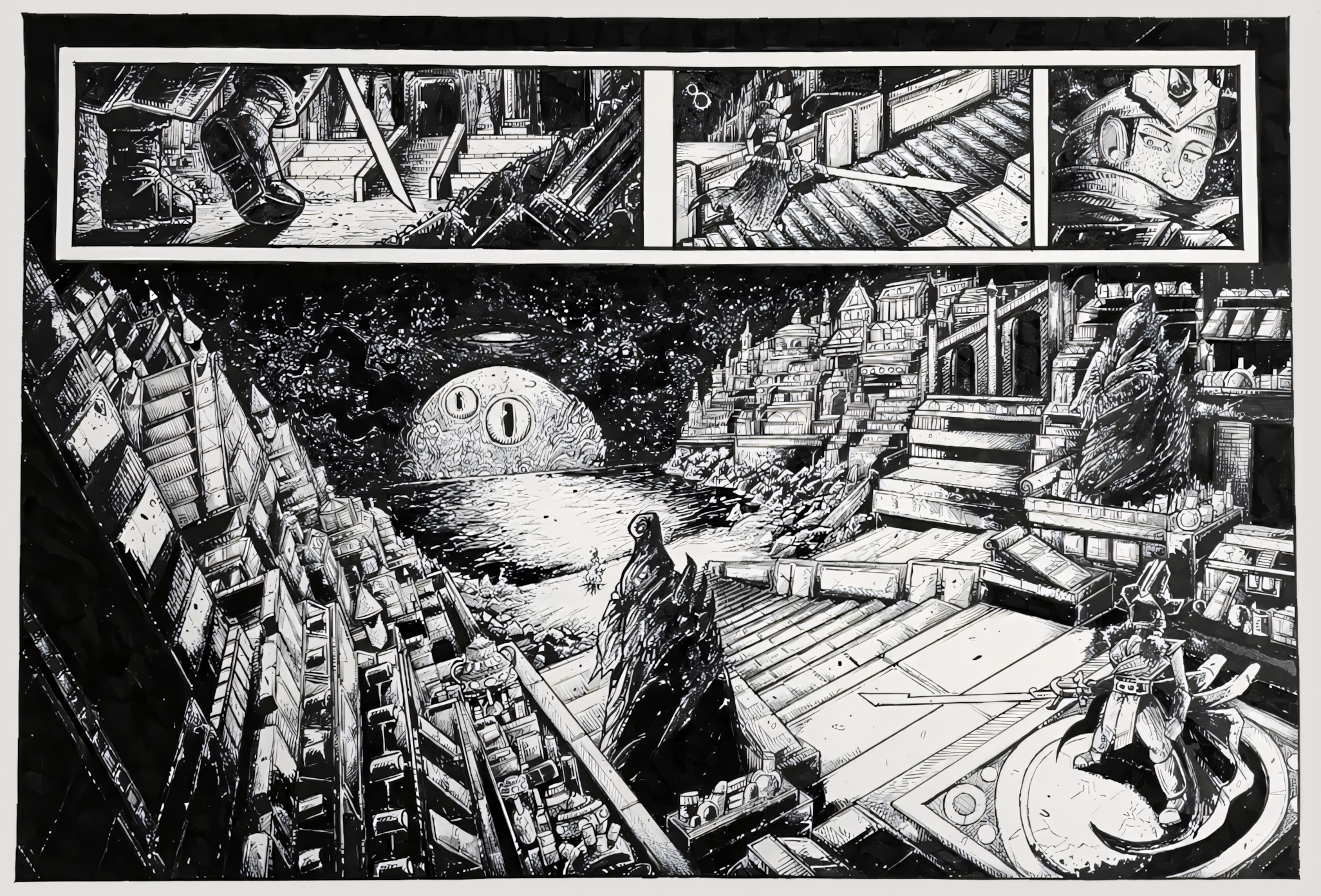
Subject: Warrior overlooking city under giant eyed moon.
Visual Style: Dark fantasy sequential comic book art.
Medium: Ink on paper
Color Palette: Black & White
Introduction
The Fortress presents a narrative. The layout utilizes panels to organize data. This format structures a sequence. Viewers encounter a story told in ink. The work balances precision with narrative mystery. The composition features a division between frames and a panoramic view. This arrangement guides the eye through space. The piece functions as an exploration of scale. It invites close inspection of the details. The drawing uses lines to create depth. It establishes a world through contrast. This artwork combines comics with illustration. The result is a hybrid form. We read the top row like a text. We experience the bottom panel like a painting. We move from tracking a sequence to spatial exploration.
Ink illustration has a history. This piece connects to traditions of storytelling. It relies on lines to define form. The artist excludes color from the canvas. This choice focuses attention on structure. The image demands participation from the viewer. One must decode the symbols within the frame and in doing so it becomes visible that narrative relies on visual cues. The composition combines architecture with character design. It merges these disciplines into a coherent image. The monochromatic approach simplifies the image. Without color, the lines are pure. The technique requires precision. An error with ink cannot be erased. The artist must plan every mark. This discipline shows in the hatching. The values are controlled.
The image occupies a physical space. A border surrounds the drawing. Within the border, a frame encloses the scenes. This frame establishes a controlled environment. The top row introduces a protagonist. The bottom panel expands the world. This transition alters the perception of scale. The viewer moves from a narrow focus to a landscape. This shift creates a rhythmic experience and mimics the act of opening a door. The reader steps into an immense environment.
What We Are Looking At
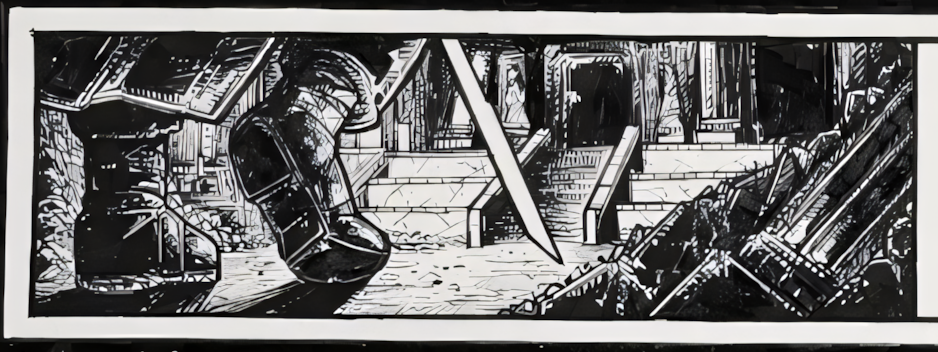
Let us examine the individual parts of the “Fortress“. The top row contains three panels. A white line bisects the row. The left panel shows a view of feet. We see boots on stairs. A sword points toward the ground. The steps lead up to a dark doorway. Columns stand on both sides of the opening. This frame captures a moment of motion. The feet move upward. The first panel uses hatching to create shadows and the lines on the boots are short. They indicate the texture of leather. The stairs are made of stone blocks. Each block has a rectangular shape. The doorway in the background is dark. The darkness inside is total. The columns have vertical lines which represent fluting. The sword blade is a white strip. It cuts across the composition.
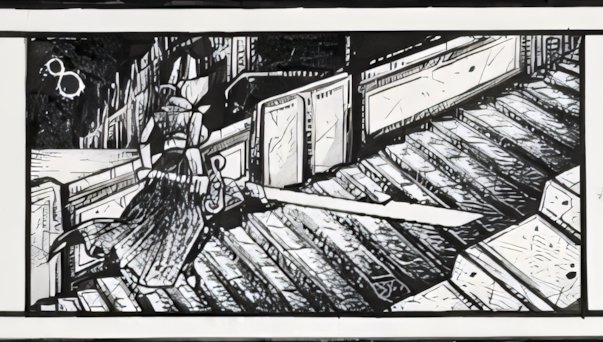
The middle panel shows the character from behind. The warrior climbs a wide staircase. The figure holds a longsword. The cape flows behind the form. In the corner, an infinity symbol appears. This mark sits in the background. The stairs occupy most of the panel. They create a diagonal pattern. The second panel increases the distance. The warrior appears smaller. The sword extends to the right. The background behind the stairs is black. The stairs fill the frame diagonally. Each step has a shadow beneath it. The shadow is a black rectangle. The cape has folds that show movement.
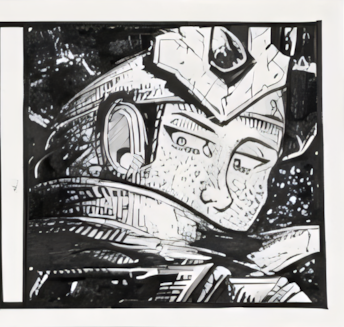
The right panel provides a profile. We see the face of the warrior. The eyes look forward with determination. A crown sits on the head. A central gem ornaments this headpiece. Shading covers the cheek. This frame provides an intimate view of the protagonist. The third panel focuses on the face. The profile shows the left eye. The eyebrow is a dark line. The crown has a point in the center. The gem is shaped like a diamond. Hatching defines the shadow on the neck. The lines are parallel to each other. They create a grey tone. The background of this panel is dark. It contains dots that look like dust.
The lower panel occupies the largest portion. This section reveals a vast landscape. The warrior stands in the corner. The figure occupies a circular platform. Lines decorate this floor. The character holds the sword. The cape extends into space. The warrior looks toward the center. The main panel expands the perspective. The viewer stands behind the character. We see what the warrior sees. The circular platform has a border. Triangles decorate the inner ring. The warrior stands in the center of this circle. The right hand grips the hilt. The blade extends horizontally. The left arm is hidden. The armor covers the torso. Plates protect the shoulders. The stone slabs on the platform show cracks. The lines are fine. They indicate the age of the floor. The circular platform has a border. Dots texture the outer ring. The warrior stands on a spot that feels stable. The boots have buckles which are drawn with tiny lines. The armor plates overlap on the legs. The belt has a large buckle in the center. The cloth around the waist has folds. The folds create shadows between the legs.
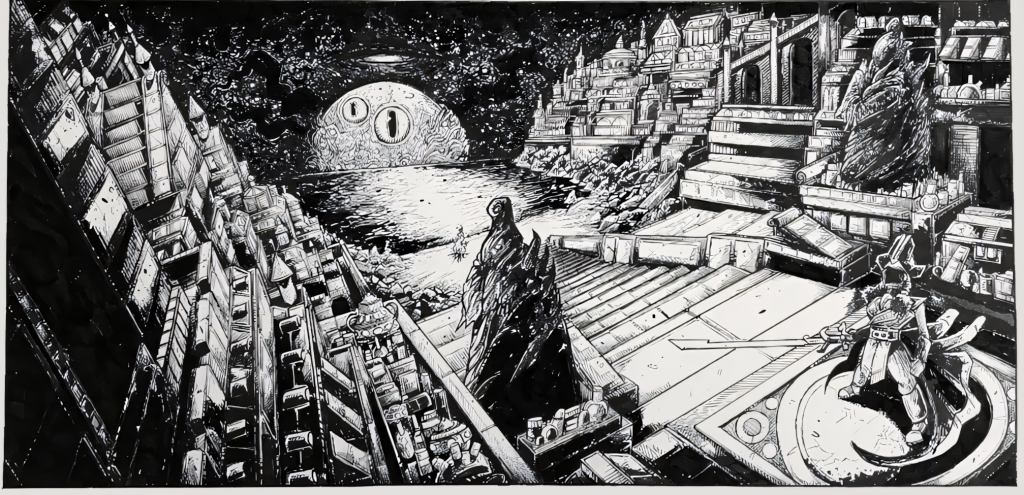
On the left side, a massive ziggurat rises. This building has many levels. The tiers recede into the distance. Shelves line the walls of this structure. These shelves hold hundreds of pots. Urns sit in neat rows. The repetition creates a dense pattern. The architecture feels ancient. The ziggurat on the left shows geometry. Each level is smaller than the lower tier. The walls lean inward. Small pillars support the roofs. The shelves are filled with jars. Each of which has a round shape. The artist drew every container. This repetition shows dedication. The shadows under the shelves are dark. They create a rhythm of black lines. On the left ziggurat, the jars have lids. Some lids are flat. Other lids are pointed. The shelves are supported by brackets. The brackets are spaced evenly. The pillars have caps at the top. The roofs are thick. The lines of the architecture are straight. They show the work of a ruler. The repetition of the jars shows order.
Between the two cities, water extends. The surface reflects light until the horizon. On the horizon, a large moon rests. The sphere is round. Inside the moon, two eyes appear. Both eyes feature a vertical slit. The eyes look at the viewer. The water separates the sides. The shore has many rocks. The rocks are round. A white path of light crosses the water. It leads directly to the moon. The moon sits on the water. The circle is perfect. The eyes inside are wide. The left eye has a round center. The right eye has a narrow slit. The campfire has logs at the base. The logs are cross-hatched to show bark. The flames are represented by white shapes. The shore consists of pebbles. The pebbles are drawn with circles.
The sky is black. The artist filled this area with ink. Dots cover the darkness. These dots form clusters. They resemble stars. The darkness fills the panel. It surrounds the moon. The sky uses stippling. Thousands of dots form the texture. The dots are dense near the top. They become sparse near the moon. This gradient creates a glow. The ink is thick. The blackness is absolute. The moon has a texture on its surface. Fine lines cover the sphere. They look like craters or veins. The glow around the moon is white. It forms a circle in the sky.
The Deeper Meaning
The artwork explores themes of observation and fate. The top sequence translates time into form. We watch an ascent. The character moves from an enclosed space to an outlook. This climb represents effort. The infinity symbol implies a cycle. The journey may repeat. This detail introduces a philosophical layer. The character is trapped in a loop. The infinity symbol in the upper row frames the story. It tells us that this event has happened before. The warrior has climbed the stairs in the past. The warrior will climb the stairs in the future. The city will always remain empty. The moon will always watch the shore. This repetition gives a tragic quality to the quest. The hero is locked in a struggle against time. The struggle is continuous.
The main panel emphasizes scale. The human figure is small. The architecture represents power. The ziggurats imply an ancient order. The streets suggest a lost people. We feel the weight of history. The civilization remains silent. Only the structures speak of the past. The architecture speaks of control. The ziggurat is organized. It displays hundreds of uniform pots. This order suggests management. The items are stored for a purpose. Perhaps they hold offerings for the deity. Perhaps they contain rations for a population. The storage implies a bureaucratic system. The city is a machine.
The moon functions as a deity. The eyes turn a celestial body into a watcher. This presence creates surveillance. The entity looks down at the landscape. The deity possesses multiple ways of seeing reality. It is an omniscient force. The choice of two different pupils in the moon suggests a divided perception. The deity possesses a human view. This duality implies that the watcher understands both intellect and instinct. The deity represents a complex system of judgment. The warrior faces this judgment. The longsword is a symbol of defense. It shows that humanity will protect its space. The platform is a stage for this meeting.
Surveillance removes privacy. The warrior cannot hide from the gaze. Every step is known to the eyes. This relationship creates tension. The character stands openly on the platform. This stance suggests defiance. The sword indicates a readiness for action. The warrior confronts the deity without fear. It is a confrontation between a mortal and a deity.
The campfire on the shore provides an interpretation. A flame burns near the water. This fire suggests a presence. Perhaps the warrior rested there. Perhaps another traveler is near. The light is tiny against the moon. It represents hope in a dark world. The flame provides a contrast to the architecture. The campfire is a sign of life. It sits on the shore between the cities. The smoke rises into the air. The fire is lonely. It is a contrast to the stone structures. The fire requires wood to burn. It is an ephemeral element. The flame represents the presence of an individual. It breaks the dominance of the architecture.
Artistic Decisions
Perspective unifies the spatial elements. The lines of the ziggurat recede to a point behind the moon. The steps on the right follow a similar direction. These lines funnel the gaze toward the center. The viewer cannot escape the eyes. The architecture acts as a guide. It directs all attention to the horizon. Linear perspective relies on a horizon line. The horizon line sits below the center of the image. The moon rests on this line. The orthogonal lines of the architecture converge at this point. The lines of the left ziggurat aim for the moon. The steps of the right city point to the moon. This convergence unifies the spatial elements. It creates a focus. The viewer follows the lines automatically. Our eyes land on the moon.
The artist uses contrast to build drama. The palette relies on pure values. Ink fills the deep voids of the sky. White paper provides the highlights on the stone. This choice creates a harsh environment. There are no tones to soften the scene. The illumination radiates from the moon. It creates reflections on the water. These reflections form a path. This path connects the background to the foreground. The choice of a monochrome palette defines the mood. Black ink creates the shadows. White paper remains as the light. This technique is called value contrast. The values are distinct. There are no mid-tones to soften the shapes. This starkness gives a graphic quality to the drawing. The lines are crisp. They define every edge with clarity.
Texture defines the materials. Fine hatching simulates stone surfaces. The lines follow the shape of the structures. This technique gives weight to the architecture. Dense stippling forms the sky. The dots create a textured pattern. This pattern contrasts with the lines of the sword. The variety of marks prevents boredom. It keeps the surface active. The hatching follows a direction. On the ziggurat, the lines are vertical. This choice emphasizes the height of the walls. On the stairs, the lines are horizontal. This orientation shows the flat surface of the steps. Cross-hatching occurs in the deep corners. The overlapping lines block the white paper. This method creates a solid tone. The black areas anchor the composition. Stippling requires a process. The artist places dots individually. The spacing of the dots determines the value. Close dots create a grey tone. Distant dots look like faint light. In the sky, the stippling forms clouds of light. This detail breaks up the dark void. It introduces an organic pattern into the space. The sky feels alive with stars.
The placement of forms creates balance. The warrior anchors the right foreground. This position counterbalances the ziggurat on the left. The hooded statue provides a marker. It breaks up the space between the city and the water. The composition utilizes a low angle. This perspective exaggerates the height of the buildings. It makes the environment feel immense. The composition uses a low viewpoint. The camera angle is down on the platform. This position makes the warrior look heroic. It makes the structures look monumental. The viewer feels small in comparison. We look up at the ziggurat. We look across at the city. This angle structures our experience of the space.
The dark sky compresses the landscape from above. It acts as a heavy weight. This compression forces the viewer to look down. The sky stabilizes the top of the frame. The ink creates a solid boundary. It holds the details together. The layout balance is precise.
Emotional Impact
The environment evokes a feeling of exposedness. The warrior stands alone in a vast space. No citizens appear on the streets. The buildings amplify this solitude. The viewer shares this experience. We stand behind the character, looking out. This positioning creates empathy. We feel the scale of the world. The scale of the image creates a feeling of insignificance. The viewer feels the immensity of the world. The warrior is a small dot against the buildings. This size difference creates tension. We wonder if the character can survive. The environment feels hostile. The stone structures offer no comfort. They are monuments of a civilization.
The structures cause anxiety. The lines and angles feel rigid. They suggest a system. The architecture controls movement. The stairs demand an ascent. There are no paths for wandering. Everything is planned. This order creates an atmospheric weight.
The presence of the eyes provokes unease. A landscape usually offers freedom. This scene looks back at the spectator. The sensation of surveillance removes comfort. It turns the environment into an actor. The viewer feels the tension.
The contrast provides a tone. The absence of color simplifies the response. We do not feel warmth. The world is cold. The highlights feel like ice. This quality reinforces the mood.
The quietness of the scene is absolute. There are no signs of wind. The water is flat. The smoke from the fire rises straight up. This stillness creates a suspension of time. The world waits for a move. The warrior stands frozen. The moon watches without blinking. The tension is constant.
Cultural or Historical Context
The visuals draw from historical sources. The buildings mimic ancient ziggurats. These structures connected earth to heaven. They were sites of worship. The artist references human history. The architecture carries associations with Mesopotamian culture.
The costume design references mythical armor. The plates belong to an epic tradition. The crown suggests status. This attire connects the work to fantasy illustration. It evokes tales of heroes. The line work resembles modern manga. The use of hatching is common. This choice positions the artwork within a visual language.
The infinity symbol connects to philosophical ideas. It represents eternal return. This concept appears in various cultures. It suggests history repeats itself. The symbol elevates the narrative. The journey becomes a struggle against repetition.
The layout follows classic principles. The use of a framing device is traditional. Artists have used borders to control focus. The creator applies this method to a narrative format. The result merges art with storytelling.
Why This Work Matters
The image deserves attention for its technical control. The artist executed every line by hand. This process demands patience. The detail on the ziggurat shows craftsmanship. Every pot is defined. The rendering creates a reality out of a fantasy concept.
The piece succeeds because it links geometry with emotion. The perspective is a narrative tool. The lines force us to confront the entity. The design choices create meaning. The work demonstrates the power of monochrome illustration. It proves that ink can build a world.
The image leaves an impression because of its silence. It captures a moment before an event. We do not see a battle. We see the preparation. This ambiguity allows the viewer to imagine the future. It lingers because it avoids answers. It invites us to return to the stairs.
The illustration demonstrates the power of graphic design. It uses panels to tell a story without words. The visual communication is clear. Anyone can understand the sequence. The ascent leads to a discovery. The landscape expands our understanding. The work shows how architecture builds narrative.