


Alessandro Scarato
Title: Dream Vision
Artist: Alessandro Scarato
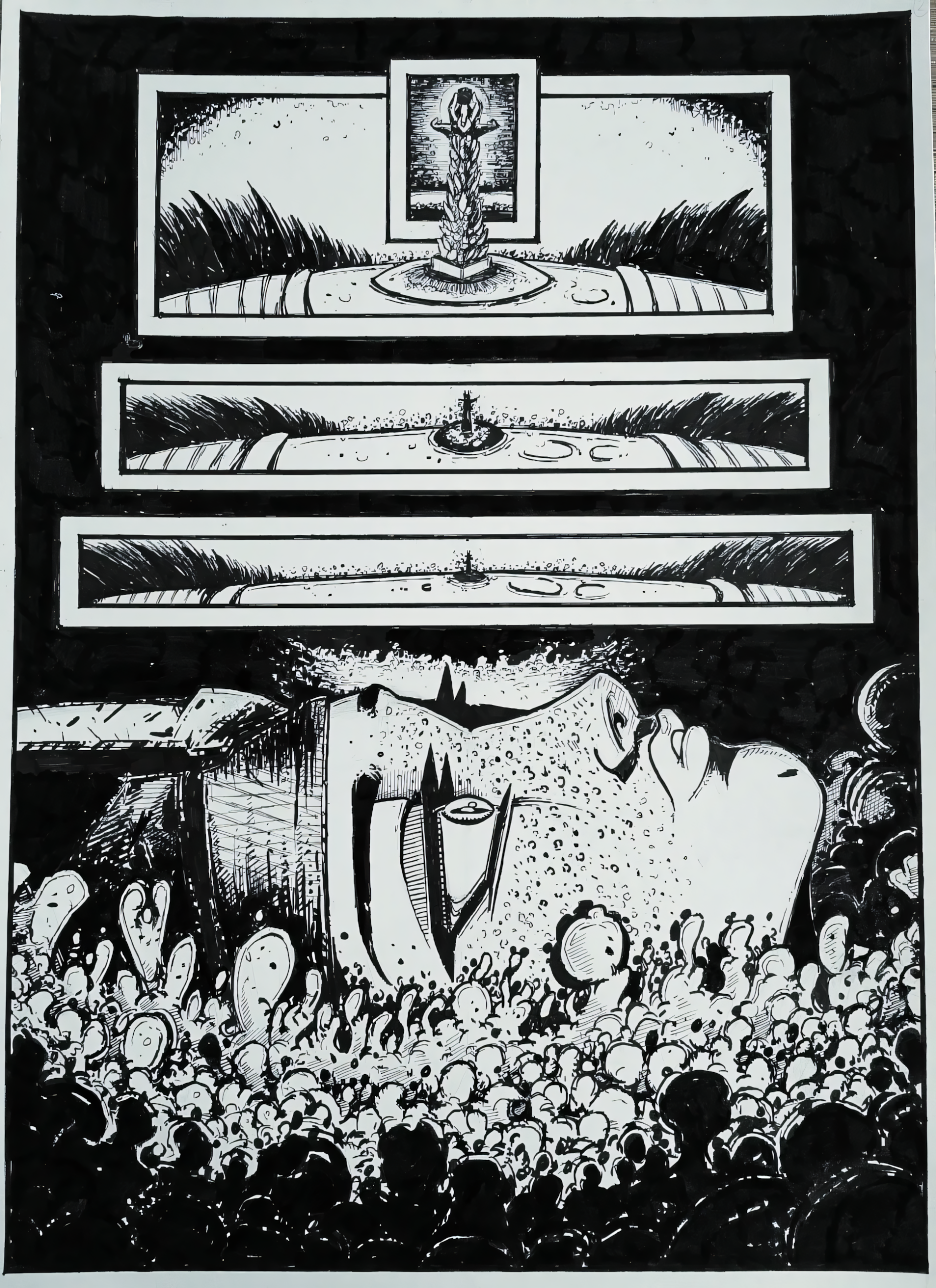
Subject: Giant head beneath sequential tower panels.
Visual Style: Dark surrealist Illustration.
Medium: Ink on paper
Color Palette: Black & White
Introduction
The intersection of sequential narrative fine art illustration creates a unique space for exploring human perception and scale. The artwork under consideration exemplifies this hybrid approach, using a vertical progression of comic-style panels that culminate in a singular figurative composition. By restricting the visual vocabulary entirely to black ink and white paper, the creator establishes a dialogue between empty space and dense form, between distant isolation and immediate collective existence.
What we are looking at
The artwork is a vertical composition rendered in black ink on a white surface, surrounded by a solid black border that contains a faint texture. The top half of the page is organized into three horizontal panels stacked vertically with white gutters separating them. The highest panel features a vertically oriented rectangular frame nested in its center, which isolates and highlights a specific focal point.
Inside this nested frame, a pillar or tower rises from a circular base. This base sits upon a gently curving horizon line, and the peak of the tower is encircled by a white halo that stands out against a lightly stippled background sky. To the far left and right edges of this upper panel, sharp, dark silhouettes resembling tall grass or reeds rise from the curved ground line.
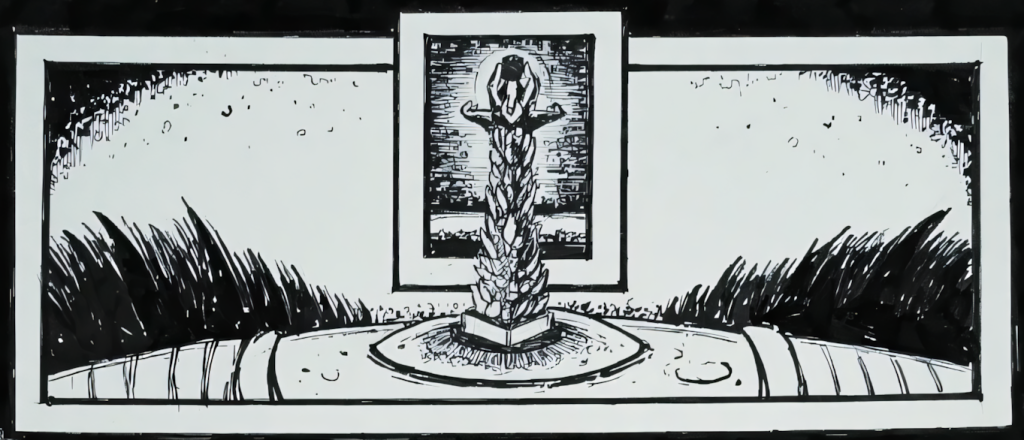
The second horizontal panel down presents a wider view of the exact same setting. The central tower is now significantly smaller and more distant, though it remains positioned on the same horizon with the silhouetted vegetation still framing the outer edges.

The third panel continues this progressive withdrawal of the viewpoint, rendering the tower as a tiny speck on the horizon line, surrounded by a light scattering of ink dots that suggest open atmosphere.

Below these three regulated frames, the lower half of the page opens into a single graphic field that breaks away from the strict geometry above. A human head is depicted resting horizontally in a right-profile view, occupying almost the entire width of the lower section. The skin of this giant figure, particularly across the cheek, nose, and jawline, is rendered with an incredibly dense application of fine stippling, creating a gradient that defines the contours of the face. The eye is closed, drawn with thick black lines, and the expression remains completely serene. At the base of this head, tightly packed crowd of organic, rounded shapes fills the lower edge of the composition.
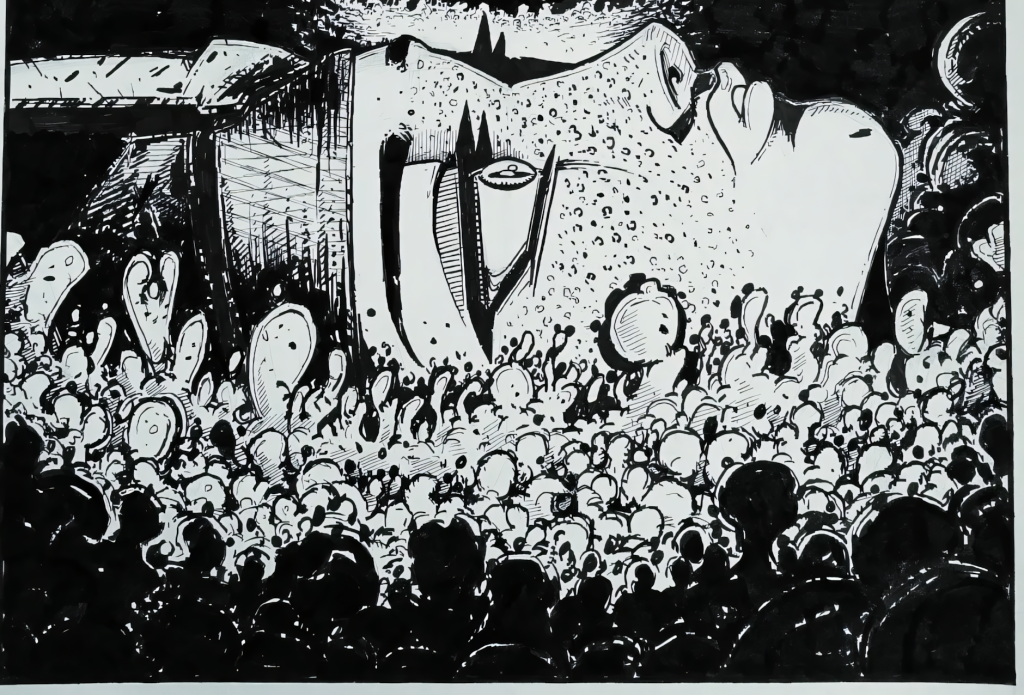
These small shapes cluster together in a dense arrangement, with the figures in the foreground rendered as flat silhouettes, while the figures slightly higher up are outlined in white with minimal markings, creating a clear sense of layering and depth within the populace. A white band of energy or light separates the upper curve of the resting head from the black field directly above it, establishing a visual boundary between the portrait and the sequential panels.
Deeper Meaning
The thematic core of this work revolves around the concept of a perspective shift, moving the viewer from a state of distant, objective observation to an experience of immediate proximity. The upper panels establish a sense of isolation, focusing on a solitary structural landmark that recedes further into the distance with each successive frame.
As the eye moves into the lower half of the composition, this clinical detachment is completely replaced by a human and communal presence. The sudden appearance of the colossal head shifts the thematic focus toward something ancient and monumental. Although the giant figure is rendered with an open eye and a calm countenance, it communicates a sense of profound rest, contemplation, or a collective subconscious state. The crowd gathering at the base of the head signifies a shared relationship between the individual members of the populace and this immense central entity.
The absolute physical contact between the tiny rounded figures and the massive face highlights themes of collective assembly, shared identity, and the reliance of a community on a larger foundational presence. The stark contrast between the quiet horizons of the upper frames and the bustling humanity of the lower section emphasizes a movement from isolation toward connection, suggesting that true scale and meaning are found within the collective human experience rather than in solitary monuments.
Artistic Decisions
Every visual element within this composition is directed by structural logic designed to guide the viewer’s eye downward in a controlled narrative sequence. The choice to stack the three horizontal panels vertically establishes a clear reading order, mimicking the natural flow of sequential art. By placing a nested frame within the very first panel, the creator forces focus on the details of the tower before allowing the gaze to expand into the wider horizontal spaces. The transition from the straight lines of the panel borders to the organic shapes of the lower illustration creates a compositional tension. The artist relies heavily on high contrast, utilizing large areas of solid black ink to frame the white paper, which ensures that the boundaries of every object remain distinct. Shape language plays a vital role in organizing the narrative space: the stable rectangles of the upper layout convey a sense of order, while the chaotic, rounded clusters of the crowd below introduce organic energy. To create dimension without the use of color, the creator employs a stippling technique across the surface of the giant face. This application of ink dots provides a middle-value gray tone that contrasts beautifully with both the flat white of the paper and the solid black background, giving the colossus a tactile surface quality that makes it feel integrated into the earth itself. The silhouetted figures at the very bottom function as a visual anchor, balancing the entire page and keeping the viewer’s eye locked within the lower field.
Emotional Impact
The psychological journey of this layout moves from detached contemplation to a state of profound awe. The viewer is positioned as a distant observer, looking across a quiet landscape that feels entirely vacant. This mood changes abruptly upon reaching the lower half of the page, where the massive scale of the human profile creates a powerful sense of connection to the first scene. The sheer size of the head relative to the tiny crowd elements produces a feeling of weight, yet this potential intimidation is balanced by the peaceful. The facial expression introduces a meditative atmosphere, turning what could be an overwhelming encounter into a moment of reverence. The crowding of the smaller shapes at the base adds an undercurrent of collective energy and shared purpose, making the viewer feel like a witness to a significant gathering. Surrounded by the black border, the entire scene evokes the feeling of discovering a sacred space tucked away from the rest of the world.