
Alessandro Scarato
Title: The Price of Ambition
Artist: Alessandro Scarato
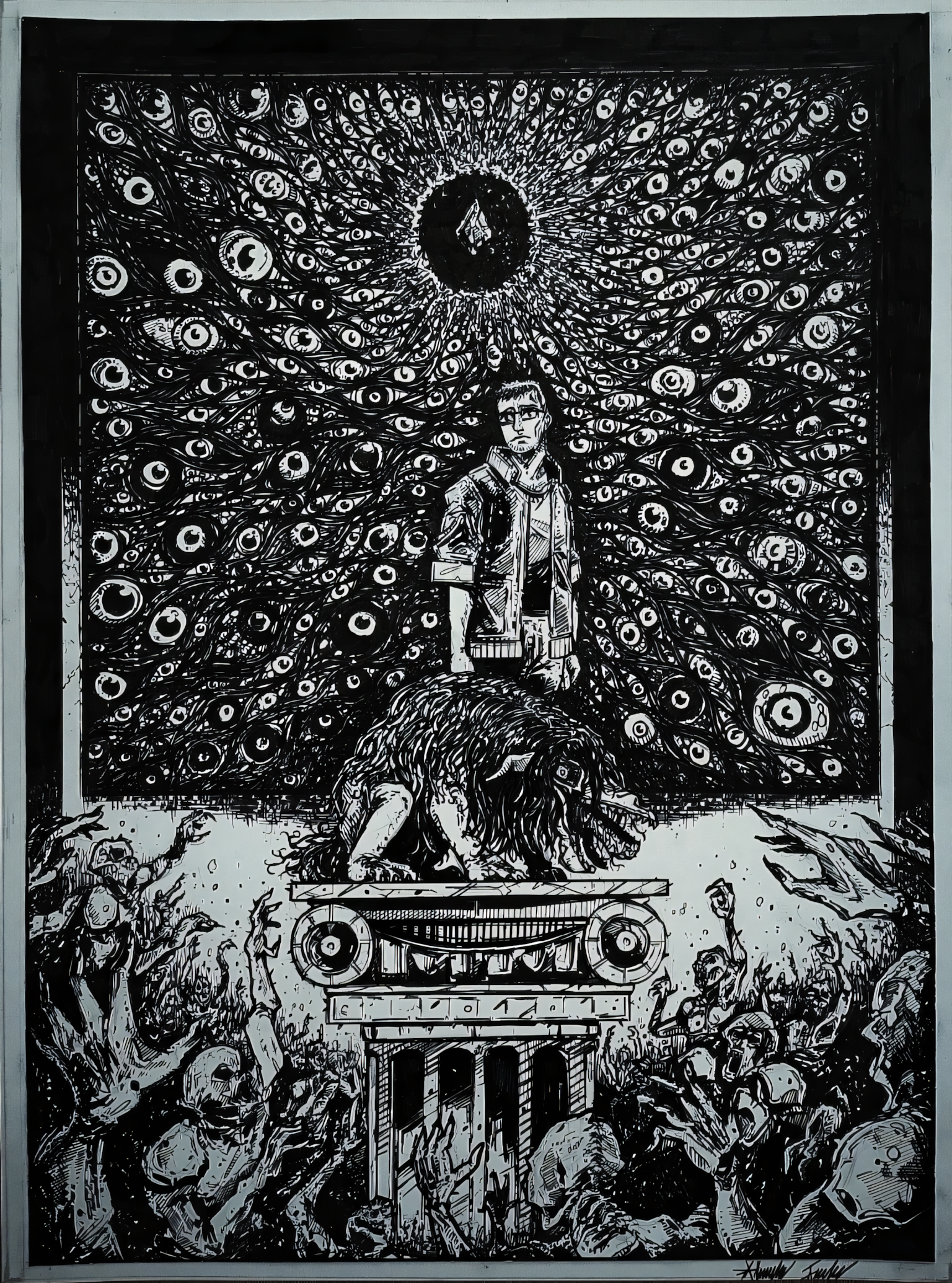
Subject: Shou Tucker on an Ionic column with the chimera, above ghouls and beneath a grid of cosmic eyes enclosing a Philosopher’s Stone
Visual Style: Dark surrealist narrative illustration
Medium: Ink on paper
Color Palette: Black & White
Introduction
Monochrome art offers a view of form. The medium relies on ink. Artist Alessandro Scarato structures a narrative about human transgression. The drawing displays a composition of dread. This piece addresses a narrative from the series Fullmetal Alchemist. The story involves a scientist named Shou Tucker. Ambition drives this character to commit a crime. He sacrifices his family for professional advancement. The canvas serves as a visual essay on isolation. Every line contributes to the atmosphere. The artwork challenges our understanding of boundaries. Viewers encounter a graphic arrangement of elements. The layout utilizes shapes to guide attention. We observe how line weight creates depth. The illustration does not comfort the observer. The work demands close inspection. This article analyzes the structural decisions of the print. We will examine how these components interact. The text explores the underlying themes of the work. This exploration reveals why the drawing remains memorable. Graphic art allows for expression of mental states. The choice of ink emphasizes a grim reality. No tones soften the visual impact. The viewer must confront the stark choices of the scientist. This image addresses an audience interested in contemporary illustration. It appeals to individuals who appreciate dark themes. The drawing unifies several motifs around a concept. Destructive obsession drives the narrative. We find ourselves questioning choices as we look at the canvas. The artwork shows what happens when pride overrides empathy.
What We Are Looking At
Skeletal humanoids occupy the border. These figures emerge from a dark abyss. Their bodies show signs of decomposition. We can observe bare ribs on several figures. Their arms extend upward in a desperate gesture. The hands feature elongated fingers that reach for the platform. Mouths suggest eternal screaming. The teeth are present within the hollow jaws. Some ghouls appear to climb over each other. Their skulls face different directions. This arrangement creates an impression of total panic. The linework in this area is loose. Short strokes create a texture of decay. The figures form an organic mass that contrasts with the architecture. They represent a layer of suffering beneath the scene. The crowd is dense on both sides of the base. Their fingers almost touch the spirals. The shadows between the limbs are black. This darkness vanishes individual forms at the bottom. The viewer senses a collective movement toward the center. Let us look at the figures at the bottom. They are clustered together in a dense arrangement. Their bones are drawn with thin lines. The artist uses white for the skeletons to make them stand out. This white contrasts with the shadows behind them. Some skulls have hollow sockets that look directly at the viewer. These sockets are small holes of ink. The teeth appear as tiny ridges along the jaws. The hands are detailed in their construction. Each finger bends at a sharp angle to show tension. The arms strain toward the base of the column. We can see ribs on the torsos. The hips and spines are also visible in some areas. The crowd seems to move like a fluid wave. This organic motion creates a feeling of instability. The figures appear to be rising from an underground prison. They fill the width of the composition. No gaps exist in the crowd along the border. The mass of ghouls forms a foundation of horror.
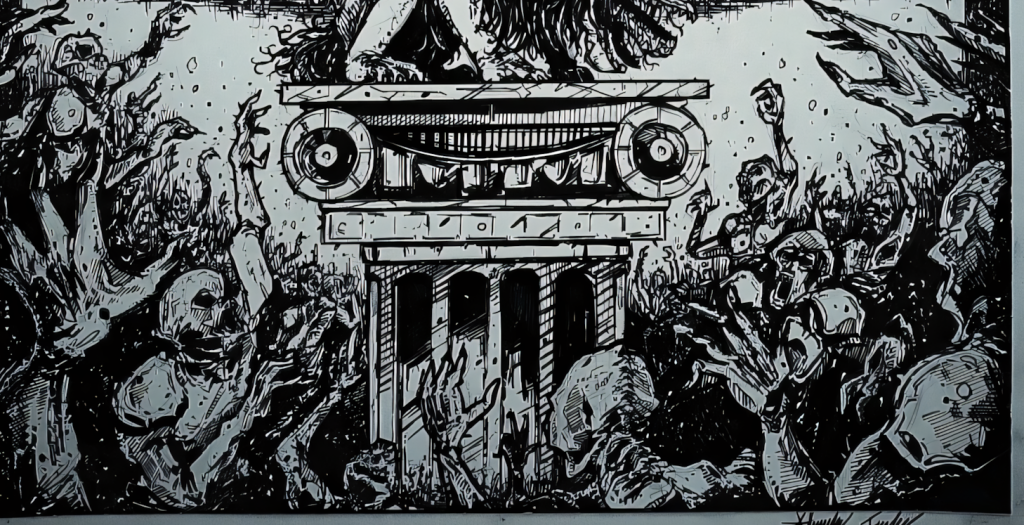
An Ionic column rises from the mass. The column stabilizes a quadrupedal creature – Nina. The capital stabilizes the middle section of the artwork. Parallel lines define the shaft of the column. The volutes display precise spirals. These scrolls represent classical design principles. The platform offers a clean surface. This horizontal element cuts across the frame. It acts as a barrier between the ghouls and the man. The architecture shows some signs of wear. Dots simulate the texture of aged marble. The column supports a large beast. It positions the “animal” directly above the reaching hands. The structure introduces a sense of balance. It anchors the elements in the lower half. The space around the shaft provides visual relief. This negative space isolates the column from the background. The shaft features lines that simulate fluting. These lines are perfectly parallel. The capital consists of two volutes. These spirals curve inward toward a point. The texture of the stone is rendered with stippling. Dots are scattered across the surface to suggest age. This technique gives the column a tactile quality. The top of the platform is a rectangle. It projects over the edges of the shaft. The beast sits squarely upon this surface. The platform holds the Nina above the hands. It creates a barrier between the levels of the composition. The space around the column remains empty. This empty space emphasizes the isolation of the platform. It shows that the structure stands apart from the chaos.
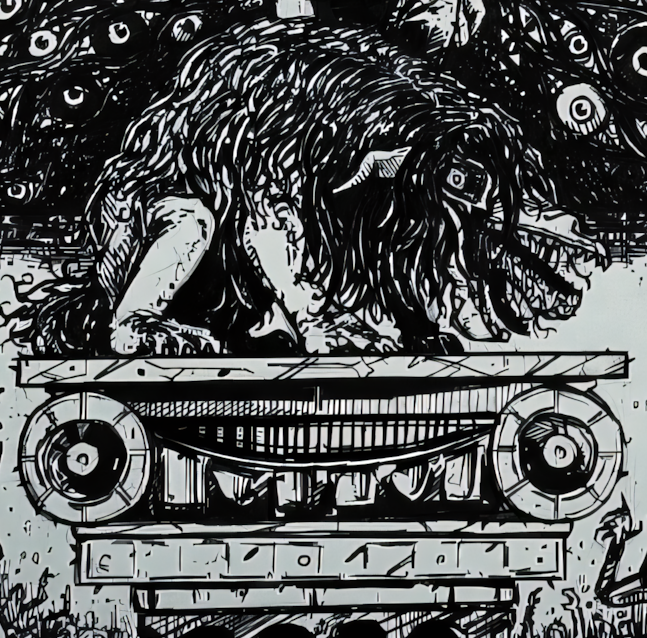
The creature faces the right side of the canvas. The artist uses short lines to render the coat. The head of the creature has a distorted shape. The mouth contains sharp teeth. The eye looks forward with a blank stare. The paws rest firmly on the flat ledge. Behind this monster stands a human figure. The figure anchors the vertical axis. He wears glasses with square lenses. His hair is cropped short. He wears a heavy jacket over a shirt. The jacket remains unbuttoned. His hands rest inside his pockets. His legs disappear behind the fur of the beast. The man looks toward the left side. His face displays an indifferent expression. He appears detached from his surroundings. His small scale contrasts with the pattern behind him. The quadrupedal beast occupies the top of the column. Its back exhibits a static posture. The fur is thick and covers the frame. The artist uses dark ink to shadow the underside of the animal. Its head is low and points to the right. The muzzle features details like whiskers and teeth. Its mouth remains slightly open. The eye is a dark circle that reflects no light. The expressionless gaze emphasizes its state. The man stands behind the creature. His torso is aligned with the center of the image. He wears square glasses that rest on his nose. His eyes are lines behind the lenses. His hair is drawn with uniform strokes. His jacket has wide lapels that frame his chest. The fabric shows creases around the shoulders. His arms are down at his sides. His hands rest inside his deep pockets. He does not interact with the beast or the background directly.
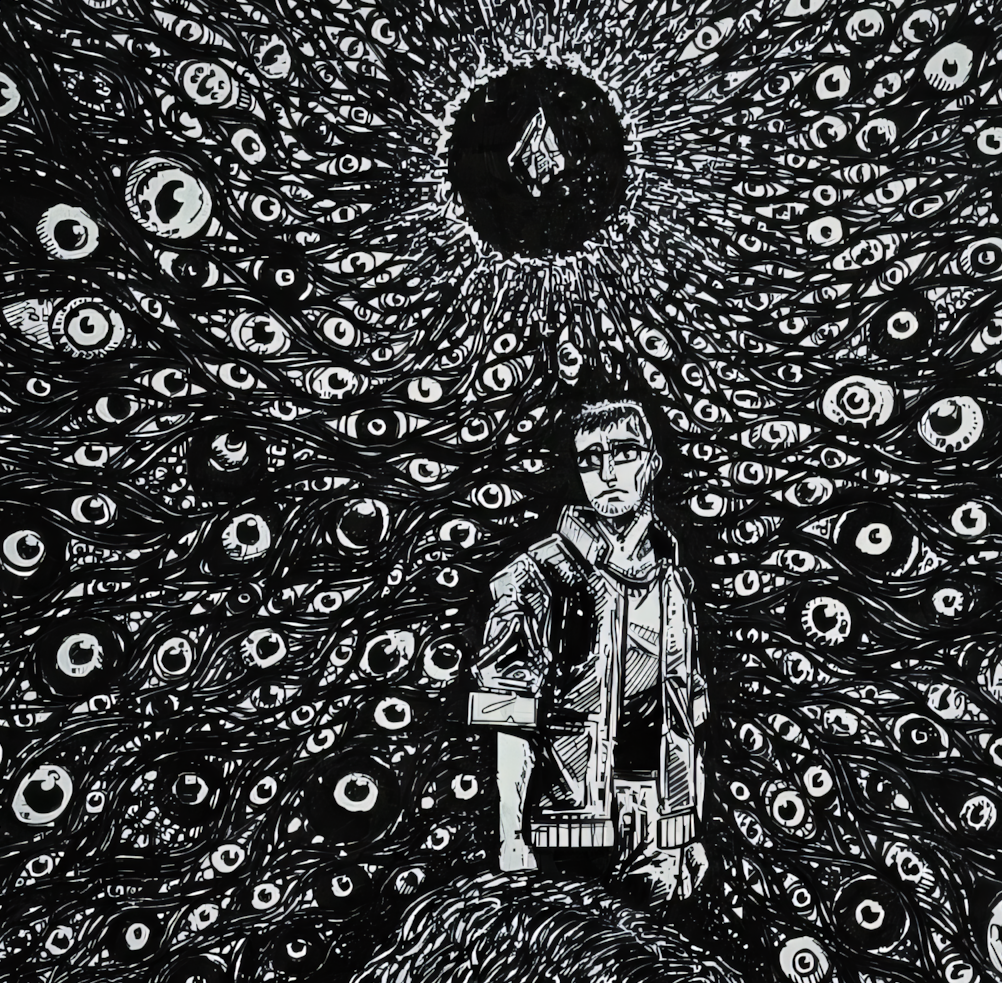
A dark frame defines the background. This rectangle contains a dense grid of eyes. The eyes are arranged in concentric rows. They fill the space. Each eye features an open lid and a pupil. The shapes radiate from a central point. The pattern funnels the gaze toward the apex. The lines are packed closely together. This density creates a dark value across the panel. In the center of the pattern sits a circle. This orb represents a void in the background. A diamond-shaped object floats inside the circle. The stone has facets. It catches the light against the dark field. The pattern of eyes surrounds this motif. The frame behind the man isolates the scene. It contains rows of eyes that form a pattern. The pattern curves around the void. The borders of the eyelids are dark. The pupils are dots in the center of the shapes. The sizes of the eyes decrease as they get closer to the orb. This change in scale creates a sense of perspective. The lines connecting the eyes are packed close together. This technique fills the background with a texture of ink. The center of this pattern features a large circle. This orb is completely black. Inside the field floats a single stone. The stone has a diamond outline. It features lines that indicate clean facets. The stone looks like a jewel in a void.
The Deeper Meaning
The illustration structures a narrative of transgression. The theme explores the cost of forbidden knowledge. We can identify specific references to the story of Fullmetal Alchemist. Shou Tucker holds the rank of State Alchemist. The military calls him the Sewing-Life Alchemist. He specializes in bio-alchemy. He achieved fame by creating a talking chimera. Nina Tucker is his daughter. She exhibits a sweet disposition. She plays with a dog named Alexander. The animal has a fluffy coat. The Elric brothers visit the scientist. They wish to study alchemy. They befriend the family during their stay. Tucker faces an evaluation every year. He feels pressure from the military. He wants to keep his certification. He needs funding for his lab. He sacrificed his wife in a past experiment. He turned her into his first chimera. Now he chooses his daughter. He fuses Nina with the dog. The result is a creature. The beast retains the mind of the child. It speaks the name of Edward. This event shatters the innocence of the brothers. It shows the cruelty of alchemical power.
His experiment translates life into a monstrous form. The beast on the column is his young daughter, Nina. He fused her with a pet dog named Alexander. This act represents supreme hubris. The column stabilizes the product of his cruel science. Architecture often symbolizes human intellect. Here, the column lifts the creator above ordinary morality. The figures below represent the forgotten victims of progress. Their collective agony forms the foundation of his status. They reach upward in a desperate plea for justice. The panel introduces a theological dimension. The eyes represent the souls used in alchemical experiments. They symbolize surveillance by a cosmic power. The orb encloses a stone. This object represents the Philosopher’s Stone, an item of power. The pursuit of this stone drives characters to commit crimes. The eyes suggest that the universe witnesses human sin. The narrative content addresses the consequences of unchecked science. The image directly translates the lore of Fullmetal Alchemist. Shou Tucker represents the danger of obsession. His pursuit of professional status led to a horrific crime. He sacrificed his family to create a talking beast. The chimera on the column embodies this tragic synthesis. By placing the beast on an Ionic capital, the artist comments on institutional pride. The column represents the elevated status of the scientist. Intellectual achievements can mask moral decay. The scientist stands above the suffering mass. He uses his position to escape the consequences of his actions. The skeletal figures represent the cost of his ambition. Every advancement requires a hidden sacrifice. The reaching hands show the agony of the victims. They are trapped in the lower realm of existence. The column stabilizes the creator’s position while crushing those below. The metaphor highlights the unfair nature of his progress.
The upper panel introduces a layer of observation. The grid of eyes represents a cosmic audience. In the anime series, the Gate of Truth features eyes. These elements symbolize the souls of the universe. They witness every transgression committed by humanity. The radiating pattern creates an atmosphere of paranoia. The character cannot escape the gaze of his victims. Even if he remains calm, the universe remembers his sin. The black orb at the top signifies truth. Inside this void rests the Philosopher’s Stone. The crystalline shape represents the object of desire. It is a symbol of power achieved through sacrifice. The eyes funnel our focus toward this prize. This choice illustrates the nature of obsession. The obsessed individual sees only the goal. He ignores the witnesses around him. The stone unifies the pattern, showing that souls are tied to its creation. The figure demonstrates a state of psychological detachment. His neutral expression suggests a lack of remorse. He does not look at the beast he created. He does not look at the eyes that judge him. His gaze is directed toward space. This orientation emphasizes his profound loneliness. Sin isolates the individual from the human realm. He stands alone on a narrow platform. His legs are hidden, suggesting he is stuck in his position. He cannot step down without falling into the crowd. He cannot climb higher because the orb blocks his path. The composition creates a trap for the character. Success has become his permanent prison. The beast acts as a barrier, separating him from the world. It is a reminder of his failure as a father. Themes include the fragility of social order. The ghouls threaten to overturn the column. Chaos waits at the edge of civilization. The artwork warns against the separation of science from ethics. Knowledge without compassion creates monsters. The viewer is invited to contemplate this lesson.
Artistic Decisions
The composition compartmentalizes into two fields. The structure utilizes a vertical hierarchy. The lower field relies on paper to create contrast. The upper panel uses ink to dominate the space. This value structure establishes a hierarchy. The black sphere at the apex claims priority. Our eyes naturally travel down the vertical axis. We move from the orb to the man, then to the beast and the column. The placement of the figure counterbalances the symmetry. He stands off-center to break the alignment. The radial pattern funnels the focus to the stone. This choice unifies the background around a focal point. The frame around the eyes creates a sense of compression. It forces the pattern into a tight space. The space around the column stabilizes the composition. It provides a place for the eye to rest amidst the dense patterns. A line bisects the vertical space. The graphic perspective compresses the space. This effect limits routes for the eye. The camera angle confronts the viewer at an eye-level viewpoint. Scale relationships reduce the importance of the human figure. The human is small compared to the field of eyes. The beast is large relative to the column capital. Sharp boundaries separate the zones. The separation emphasizes a division between the world below and the space above.
The artist employs contrasting shapes to convey meaning. Circles dominate the panel of the artwork. The repeating circles generate a feeling of surveillance. A sphere represents perfection in design. Here, the black sphere represents a void. Triangles define the section of the composition. The hands and fingers form sharp points that project upward. Triangles create a feeling of danger. The diamond shape introduces synthetic geometry. Its facets contrast with the organic shapes of the eyes. The spirals introduce classical order. This geometric balance suggests a struggle between intellect and chaos. The lines of the ghouls provoke anxiety.
The ink palette reinforces a grim atmosphere. There are no soft gradients in this illustration. The values rely on sharp boundaries between black and white. This contrast creates a division between the zones. Fields of black represent the unknown elements of the universe. White space signifies vulnerability. The artist uses fine lines to build up values. Hatching and cross-hatching create a sense of density. Ink pools create solid areas that anchor the frame. The lighting appears to originate from the bottom. This light casts shadows upward. It isolates the character against the background. The artwork translates mental tension into ink. The medium relies on ink and white space. The artist uses lines to build a cold atmosphere. The value structure defines the image, where fields contrast with paper. Shadows cover sections of objects and fill the recesses of the background. Cross-hatching simulates an oppressive atmosphere in the frame. The lighting isolates the character, casting him against the background to emphasize solitude. Linework creates rough textures across the canvas. The artist differentiates materials through stroke types. Strokes define the thick fur of the beast. Lines depict the smooth surface of the column. Stippling creates a granular texture in the shadows of the platform. The density of the section overpowers the lower half. This deliberate imbalance creates a feeling of dread. The textures heighten the physical discomfort of the scene. The precision of the rendering keeps the composition clear despite the detail. The techniques include lines, cross-hatching, and pointillism. The work demonstrates illustration techniques, using fineliners and pens. The rendering approach builds tone through hatching and stippling. The control is precise, maintaining clarity despite the density of the patterns. The reliance on ink limits transitions, forcing a reliance on values.
The grid contains hundreds of eyes. The lids are drawn with black ink. The lines are thick around the edges. The pupils are small dots. They point toward the center. The sizes vary across the background. The elements shrink near the orb. This scaling structures a sense of depth. The fields around the eyes are dark. Cross-hatching fills the gaps between the shapes. This texture covers the panel. The layout compresses the imagery into a frame. The frame unifies the section. The orb in the center is a circle. The circle is filled with ink. The stone inside has a diamond contour. Lines indicate the facets of the jewel. The object seems to float in the void.
The column has a fluted shaft. Parallel lines run down the marble. The volutes form spirals on each side. The architecture represents classical reason. The platform has a rectangular surface. The edge shows signs of wear. Stippling creates a granular texture. The shadow beneath the ledge is deep. The creature rests on the stone. Its coat has coarse fur. Short marks indicate the texture of the animal. The snout features sharp teeth. The jaws are slightly open. The eye of the beast is a circle. The gaze is fixed on the right. The man stands behind the animal. He wears square glasses on his face. His expression is neutral. He places his hands in his pockets. His jacket has wide lapels. Creases cover the fabric of his clothes. The crowd below reaches for the base. Skulls face different directions in the mass. Mouths are open in a scream. Ribs are visible on the skeletons. The bones are white against the background. Hands extend with long fingers. The limbs twist in agony. The figures are dense along the bottom.
Emotional Impact
The primary response to this illustration is a feeling of dread. The field of eyes creates a sensation of paranoia. Viewers feel watched by an infinite audience. The patterns generate a form of visual vertigo. The gaze is pulled into the central void. This movement creates a feeling of helplessness. The sharp points of the hands provoke a reaction. The viewer experiences the discomfort of a crowded space. The movement at the bottom contrasts with the stillness of the man. This contrast increases the emotional tension of the piece. We are trapped between the panic below and the observation above. The atmosphere transmits a feeling of dread. The viewer experiences vertigo from the patterns and discomfort from the hands. The combination of elements structures a trap for the viewer. The tension remains unresolved, as the human looks away from the eye. The beast on the column evokes a mixture of sympathy and repulsion. Its form is repulsive to the observer. However, the context of its creation inspires sadness. The blank stare of the animal conveys a state of suffering. It cannot express its pain through words. It sits as a silent monument to a father’s crime. The presence of the man provokes anger in the viewer. His calm demeanour is disturbing given the circumstances.
Cultural or Historical Context
The style of this piece connects to specific illustration traditions. We can observe the influence of Japanese manga artists. The patterns resemble the work of Kentaro Miura. The unsettling atmosphere shares elements with the stories of Junji Ito. These creators use detailed linework to construct horror scenes. The image also draws from the genre of cosmic horror. In cosmic horror, humanity is insignificant compared to these forces. The field of eyes reduces the importance of the human figure. He is small against the backdrop of the universe. His knowledge is minor compared to the truth of the stone. The style aligns with fantasy illustration. It shares the intensity of Expressionism and the arrangement of Surrealism. This work relies on the line work of poster design. The piece connects to the tradition of Memento Mori art. This tradition reminds viewers of mortality through the figures. Skeletons appeared in medieval art to represent the dance of death. Here, they represent the victims of scientific advancement. The use of a column connects to architectural history. Greek columns represented order, reason, and civilization. By placing a monster on top, the artwork subverts these ideals. Reason has been used to create something unnatural. The illustration combines these diverse symbols into a narrative.
Why This Work Matters
This artwork deserves attention because it addresses a relevant issue. The story of Shou Tucker serves as a warning. Society faces many ethical dilemmas regarding technology. Technology presents serious risks. When progress ignores morality, suffering increases. The drawing translates this debate into an image. It forces us to consider the foundation of our achievements. Are we building our civilization on the backs of victims? The column reminds us that our structures are fragile. If the base collapses, the system falls. The goals are to communicate themes of paranoia, isolation, and the collapse of order. Structures break when caught between chaos and cosmic forces. The column acts as a metaphor for structures holding back chaos. The presence of ghouls attacking the base provides evidence of a threat to order. The artwork excels in pattern creation and tension. It integrates motifs with formal discipline. The piece demonstrates the capability of monochrome art. Without color, the artist must rely entirely on line and value. This limitation forces a high level of discipline. The execution shows that illustration can convey complex ideas. It proves that fan art can achieve significance. The work transcends its original source material. It stands alone as an exploration of guilt and surveillance. Designers can study this piece to learn about texture and hierarchy. It provides an example of using patterns to create weight. The drawing remains in the mind long after inspection. An illustration that excels in pattern creation requires study. Precision in execution and control defines the quality of the ink work. The integration of motifs produces an image. The density of the pattern ensures that the impact remains permanent. Viewers leave the gallery with an understanding of storytelling. The print demonstrates that line art can compete with paintings in narrative depth. It challenges us to look closely at the choices that shape our world.